
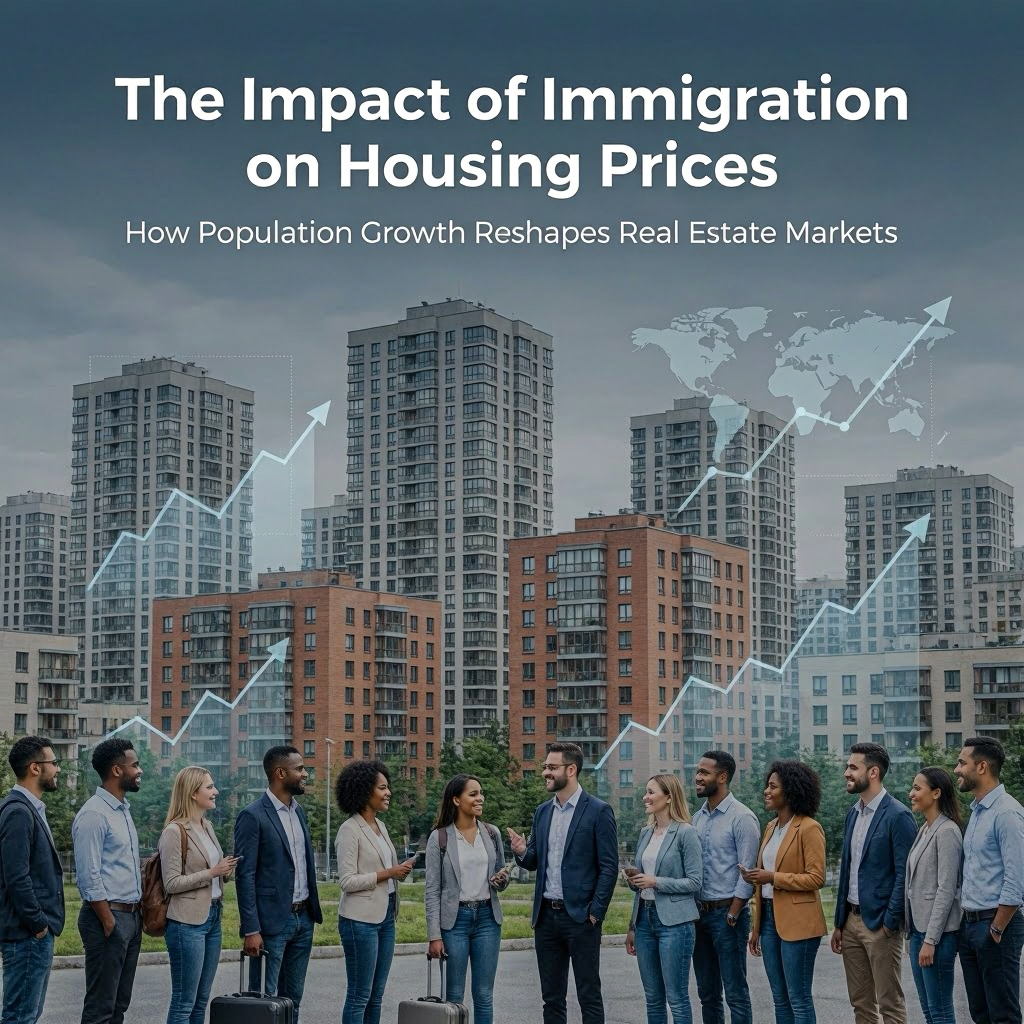
Housing prices have become one of the most widely discussed economic issues in cities worldwide. As rents climb and homeownership slips further out of reach for many households, people are asking what is really driving the change. One factor that often enters the conversation is immigration, a subject that intersects with economics, public policy, labor markets, and community growth simultaneously.
The relationship between immigration and housing prices is not simple. New arrivals can increase demand for homes and rentals, but they also contribute to labor supply, business growth, tax revenues, and neighborhood vitality. That means the effect of immigration on housing cannot be reduced to a single number or a single story. Instead, it must be understood as part of a larger system shaped by supply, demand, wages, zoning, and government policy.
This article explores how immigration influences housing markets, why some cities feel the pressure more than others, and what policy approaches can help communities stay both welcoming and affordable. By the end, you will see that the housing conversation is not only about population growth, but also about how well cities plan for it.
Immigration and demand
At its most basic level, housing is a supply-and-demand market. When more people move into an area, the need for shelter rises. Immigrants contribute to that increase in demand because they need places to live just like everyone else, whether they are renting apartments, buying starter homes, or sharing housing with family members.
This demand effect is often strongest in places where jobs are concentrated. Large metro areas tend to attract newcomers because they offer employment, transportation, schools, and community networks. When the number of available homes does not keep pace with the number of new residents, competition increases, and prices usually move upward.
However, demand is only one side of the story. A growing population can be a sign of a healthy, expanding city, especially if the local economy is strong. The challenge is not the presence of newcomers itself, but whether housing supply can adjust quickly enough to support growth without making homes unaffordable for long-term residents.
Supply constraints
Housing supply is often slower to respond than housing demand. Building new homes takes time, money, land, labor, and government approval. In cities with restrictive zoning, limited vacant land, or high construction costs, supply may lag behind population growth for years
That delay creates pressure in the market. If a neighborhood can only absorb a small number of new units each year but continues to receive new residents, landlords and sellers may raise prices because there are more buyers and renters than available homes. This is one reason some urban markets remain expensive even when wage growth is modest.
In many cases, the supply problem existed before immigration became part of the debate. Long permitting timelines, underbuilding after recessions, and resistance to denser development can all contribute to scarcity. Immigration then adds extra demand to an already tight system, making affordability problems more visible.
Economic contributions
It is important to recognize that immigrants do more than increase demand for housing. They also help drive the broader economy. Many fill essential jobs in healthcare, construction, hospitality, logistics, agriculture, and technology. Those jobs support consumer spending, business growth, and local tax bases
When immigrants earn income, they spend it in local communities, rent apartments, buy goods, and pay taxes. That activity can strengthen neighborhoods and support additional development. In the long term, a larger labor force can also help expand housing supply if enough workers are available to build homes and infrastructure.
This creates an important balance. Immigration can contribute to housing pressure in the short term while also supporting the economic conditions needed for long-term housing production. The real policy question is whether cities can channel that growth into construction, infrastructure, and planning rather than into scarcity and bidding wars.
City examples
The impact of immigration on housing prices looks different depending on the city. In places with strong job markets and limited land, prices can rise rapidly because demand stacks on top of existing scarcity. In other regions, the market may absorb new residents with less stress because housing stock is more flexible or more plentiful.
The article on honeybunns.com points to cities such as San Francisco, New York, and Toronto as examples of places where immigration and housing pressure intersect in visible ways. Each city has its own policy choices, housing rules, and demographic patterns, so the results are not identical. Some cities respond with more construction, while others face continued affordability problems because supply remains constrained
The main lesson is that local context matters. Two cities can receive similar levels of population growth and still experience very different housing outcomes depending on how much they build, how they regulate development, and how they support transit and infrastructure.
Policy options
If a city wants to remain affordable while continuing to grow, it needs a housing strategy, not just a reaction. Affordable housing programs are one option, especially when they focus on households most likely to be priced out of the market. Subsidies, income-restricted units, and public-private partnerships can help create breathing room for families under pressure
Zoning reform is another major tool. Many urban areas restrict the construction of duplexes, triplexes, and multifamily housing in neighborhoods where demand is high. Loosening those restrictions can make it easier to add homes near jobs, schools, and transit lines.
Community planning also matters. When residents, developers, and local officials work together early in the process, it becomes easier to balance growth with livability. That approach can reduce conflict and create housing that serves both newcomers and long-term residents.
Misconceptions
One common misconception is that immigration alone causes housing prices to rise. In reality, housing markets are shaped by many variables, including interest rates, wage levels, investor activity, construction costs, zoning rules, and available land. Immigration is only one part of that equation
Another misconception is that fewer immigrants would automatically make housing affordable. That may reduce demand in the short term, but it would not fix a city’s structural supply problems. If a market is underbuilding, restrictive, or overregulated, affordability issues may persist regardless of population trends
A more accurate view is that immigration can expose weaknesses in a housing system. It highlights where supply is too tight, where policy is too slow, and where planning has not kept up with growth
What communities need
Communities facing housing pressure need a practical mix of policies. They need more homes, faster approvals, better infrastructure, and smarter land use planning. They also need a public conversation that avoids oversimplification and focuses on solutions rather than blame.
A healthy housing system should be able to accommodate change. That means planning for population growth before a crisis hits, not after prices have already surged. It also means supporting workforce housing, transit-oriented development, and a wider range of home sizes so that people at different income levels can find a place to live.
When cities fail to plan, newcomers and longtime residents alike suffer. But when they plan well, immigration can be part of a broader story of growth, opportunity, and neighborhood renewal.
Conclusion
Immigration and housing prices are linked, but not in a simplistic way. New residents increase demand, yet they also strengthen the labor force and local economy. The real driver of affordability problems is often the mismatch between population growth and housing supply.
Cities that want to stay competitive and welcoming must build more homes, modernize zoning, and invest in infrastructure. If they do, population growth can be managed in a way that supports affordability rather than undermining it.
The strongest takeaway is that housing challenges are solvable when policymakers treat them as planning problems instead of cultural arguments. Immigration may shape the market, but housing policy determines how that market responds.