
It’s been a history-making last five weeks for Wall Street. In no particular order, we’ve witnessed:
- The iconic Dow Jones Industrial Average (^DJI +0.14%), widely followed S&P 500 (^GSPC +1.08%), and technology-fueled Nasdaq Composite (^IXIC +1.91%) jump to record highs.
- The largest-ever initial public offering in Wall Street’s history: Space Exploration Technologies (SpaceX).
- The start of a new era at the Federal Reserve, with Jerome Powell’s term as Fed chair ending on May 15, and Kevin Warsh’s tenure officially starting on May 22.
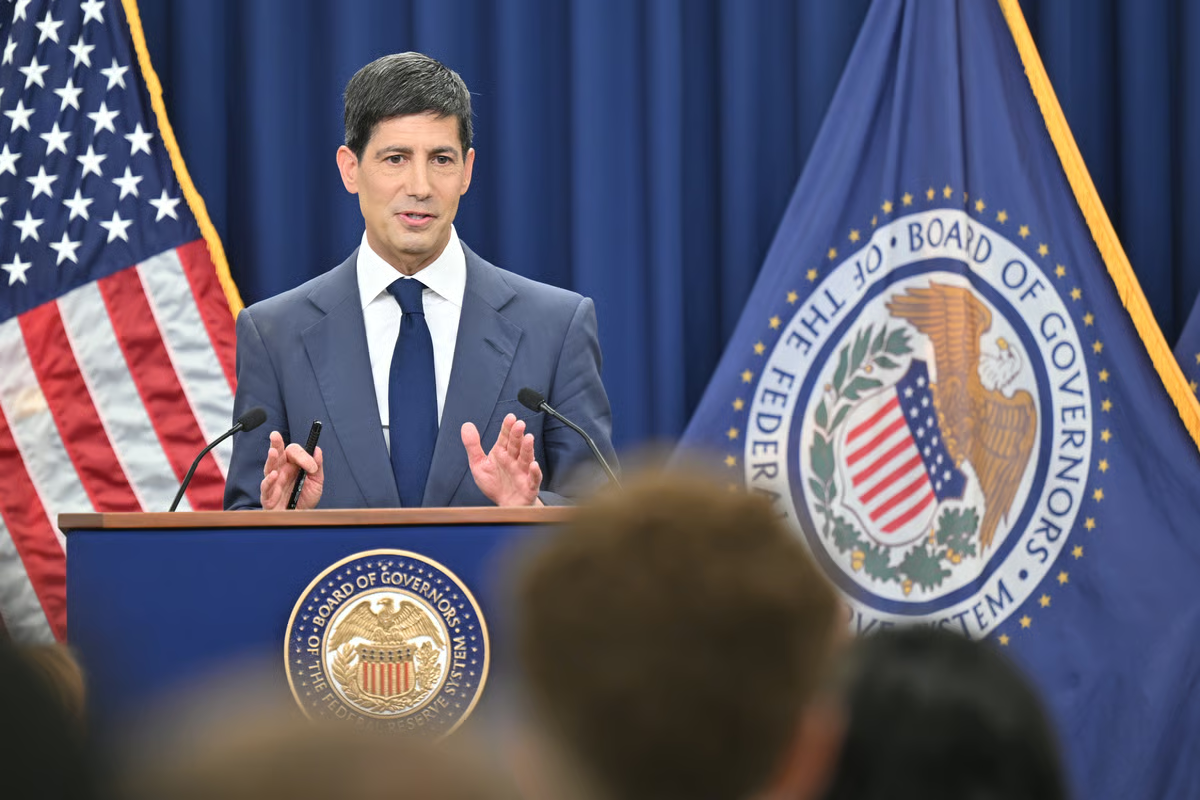
President Donald Trump’s handpicked successor to Powell became the center of attention for financial markets last week. On June 17, Warsh led his first Federal Open Market Committee (FOMC) meeting as Fed chair — and it was a doozy.
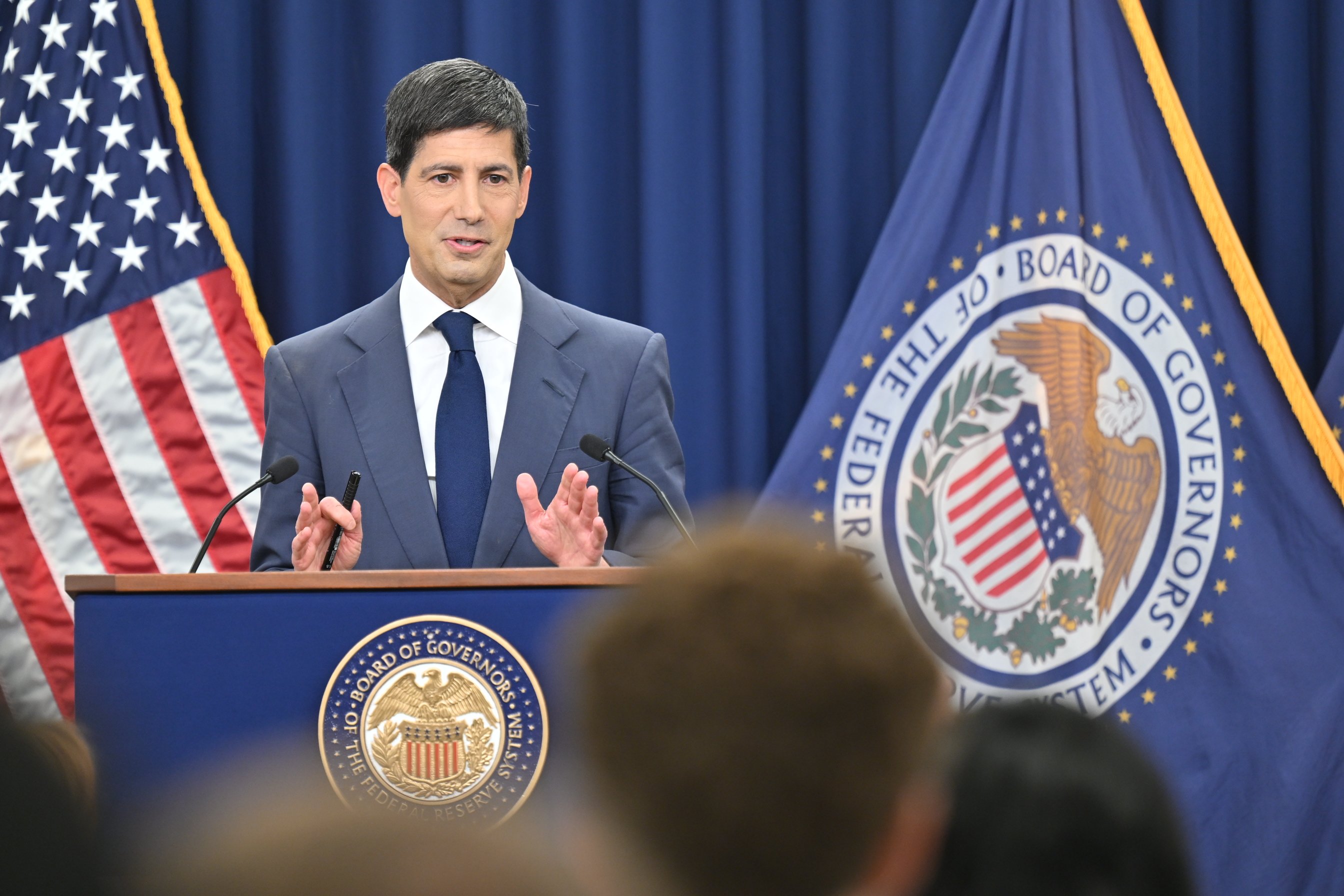
Fed Chair Kevin Warsh delivering remarks. Image source: Official Federal Reserve Photo.
While some things went as expected, a Kevin Warsh-led Fed brought several surprises to the table for Wall Street and investors. This included subtly throwing President Trump and former Fed Chair Powell under the bus concerning inflation.
Fed Chair Warsh lumps the blame for elevated inflation on his predecessor and the president
As expected, the FOMC — the 12-person body, including Warsh, responsible for setting the nation’s monetary policy — left the federal funds target rate unchanged on June 17. But it’s what Fed Chair Kevin Warsh said while speaking with the press after his first FOMC meeting that’s raising eyebrows and sounding alarm bells.
Breaking from Powell’s tradition of sharing the FOMC’s thought process and offering forward-looking guidance, the Federal Reserve’s FOMC statement was short and to the point under Warsh, noting that “inflation remains elevated relative to the Committee’s 2 percent goal.”
During his press conference following the FOMC meeting, Warsh bluntly stated,
The commitment to deliver [price stability] is strong, unanimous, and unambiguous. And that’s an important message we’ve missed for five years. And we’re going to fix that.
Warsh plainly assigns blame for elevated inflation to his predecessor, Jerome Powell, for keeping interest rates at record lows for too long, as well as for allowing the central bank to balloon its balance sheet with long-term Treasury bonds and mortgage-backed securities.
Kevin Warsh just ended his first ever FOMC meeting as Fed chair.
His message to markets: “I can’t give you any guidance on what we’re going to do next.”
Here is what he said:
1. Inflation is still way above the Fed’s 2% target and prices are too high for most people
2. “We… pic.twitter.com/rAjaqRu7HV
— Bull Theory (@BullTheoryio) June 17, 2026
But Powell isn’t the only key figure that’s subtly thrown under the bus by Kevin Warsh in his first FOMC meeting as Fed chair. While the new head of the Fed didn’t mention Powell or Trump by name in any of his remarks, his comments to the press about elevated inflation inadvertently placed the onus of blame on the president:
Inflation remains elevated relative to the Committee’s 2% goal. In part, reflecting supply shocks that have driven price increases in certain sectors, including energy.
Although Warsh didn’t directly address the Iran war, his singling out of the energy sector speaks volumes. Trump’s decision to attack Iran on Feb. 28, and Iran’s subsequent closure of the Strait of Hormuz, led to the largest energy supply disruption in modern history. Energy prices soared in the wake of this closure, pushing U.S. trailing 12-month inflation from 2.4% in February to a three-year high of 4.2% in May.
However, it’s worth pointing out that Warsh used the plural of “sectors” in his discussion. While energy prices tied to the Iran war remain the key catalyst for elevated inflation, President Trump’s tariffs have also been a persistent thorn for prices in the goods sector.

Image source: Getty Images.
Bye-bye transparency! Hello, rate hikes?
But subtly assigning blame for persistently elevated inflation was only part of the story of Kevin Warsh’s first meeting as Fed chief. He also offered expected but disturbing guidance on what’s to come from policymakers and danced around a worrisome dot plot.
Perhaps the most profound statement made by Warsh in response to a question from the press was that “forward guidance isn’t the business we should be in.”
Before being confirmed as Fed chair by the Senate Banking Committee, Warsh’s testimony pointed to his desire to rid the central bank of most forward-looking guidance. He’s long believed that financial markets operate inefficiently when they move because of whims rather than facts.
BREAKING: Fed Chair Kevin Warsh announces that the Fed has “dropped” forward guidance.
“Forward guidance is not the business we should be in,” he says.
— The Kobeissi Letter (@KobeissiLetter) June 17, 2026
The issue is that Wall Street and investors have become somewhat addicted to the transparency and forward-looking data provided by the central bank. Even though policymakers are fallible and the FOMC has been behind the curve in adjusting its monetary policy stance on several occasions, transparency and predictability are highly valued attributes by Wall Street and investors.
Without much in the way of forward-looking guidance, predicting what a Warsh-led Fed will do next becomes far more difficult. For the second-priciest stock market in history (dating back 155 years), a sudden lack of monetary policy transparency is unlikely to sit well with investors.
At the same time, Warsh’s first FOMC meeting as Fed chair coincided with the quarterly release of the Summary of Economic Projections, which is more commonly known as the “dot plot.” The dot plot anonymously projects where each of 19 policymakers (not all 19 are voting FOMC members) expects interest rates to head.
At the start of the year, the bond market was pricing in 2 Fed rate CUTS.
After today’s FOMC meeting, it is now pricing in 2 Fed rate HIKES.
That’s a 1% swing in expectations.
The 2-Year Treasury yield entered the year at 3.48%. It ended the day at 4.21%. pic.twitter.com/zvVru7ValQ
— Charlie Bilello (@charliebilello) June 17, 2026
Warsh confirmed that he abstained from submitting forward-looking guidance via the dot plot. However, nine of his other 18 colleagues projected that interest rates would be higher than they are currently by the end of 2026.
Higher interest rates have the potential to slow the artificial intelligence data center build-out that has primarily fueled the Dow’s, S&P 500’s, and Nasdaq’s historic rallies.
It’s a brand-new era for the Federal Reserve, and Wall Street is simply along for the ride.