

Strategy (formerly MicroStrategy) raised $335.5 million by selling common stock last week, then placed almost 90% of the proceeds into cash rather than Bitcoin as the company moved to shore up the preferred securities financing its cryptocurrency purchases.
The company sold about 2.71 million MSTR shares between June 15 and June 21 and added $300 million to its US dollar reserve, lifting the fund to $1.4 billion. It spent the remaining $34.9 million on 520 Bitcoin.
The allocation followed a sharp selloff in Strategy’s STRC perpetual preferred shares, which fell to a record intraday low of $82.50. STRC had been designed to trade near its $100 stated value and has become one of the company’s most important sources of capital for buying Bitcoin.
Strategy sold no preferred shares during the week, relying entirely on its at-the-market program for common stock. The move diluted MSTR shareholders but increased the cash available to cover dividends and interest across the company’s expanding capital structure.
MSTR common stock becomes STRC backstop?
The financing decision showed how Strategy can use its common equity when demand for its preferred securities weakens.
STRC has about $10.5 billion in stated value outstanding and pays an annualized dividend of 11.5%. Strategy typically sells new STRC shares when they trade at or above $100, using the proceeds to buy Bitcoin or meet other corporate needs.
That channel effectively closed as STRC dropped below its stated value. Selling additional shares at a discount would raise less cash while adding dividend obligations calculated against the full $100 amount.
Instead, Strategy issued MSTR and used most of the proceeds to increase its liquidity reserve.
Quinn Thompson, chief investment officer at Lekker Capital, said the decision was the first recent indication that Strategy understood investor concerns and was prepared to address them.
Thompson had urged the company to use common-stock issuance to build cash and strengthen the balance sheet rather than direct all new capital toward Bitcoin. He said:
“This is exactly what we’ve been advocating for — use MSTR issuance to raise cash to bolster the balance sheet.”
He added that the action should support the preferred securities and other claims above common stock in Strategy’s capital structure. It could also reduce the risk that the company would eventually need to sell Bitcoin to meet its obligations.
Thompson cautioned that Strategy still had more work to do and that additional common-stock issuance could keep pressure on MSTR.
Indeed, the latest filing showed that Strategy’s diluted share count rose to about 388.6 million from 386.1 million a week earlier. Its year-to-date BTC Yield, a company metric measuring changes in Bitcoin holdings relative to diluted shares, declined to 11.8% from 13% four weeks earlier.
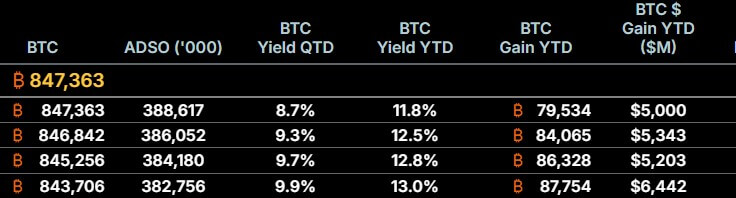
The decline reflects the cost of issuing common shares, with most proceeds directed into cash rather than additional Bitcoin.
STRC rebounds but Remains Under Pressure
STRC initially recovered above $91 following the reserve announcement, then closed Monday at $88.64. MSTR also advanced in early market trading but reversed, finishing 2.7% lower at $109.52.
The price action suggested the cash increase eased some immediate concerns without restoring STRC to the range where Strategy could comfortably resume issuing the security.
Bitwise Europe said forced liquidations by leveraged investors contributed to the selloff, rather than a sudden deterioration in Strategy’s ability to meet its obligations.
The decline nevertheless exposed investor concerns about the preferred shares’ sensitivity to Bitcoin prices, market liquidity, and interest rates. STRC has no maturity date, and investors are not guaranteed that it will return to $100.
Supporters argue that the discount itself could attract buyers because STRC’s $11.50 annual dividend represents a higher effective yield when the security trades below its stated value.
Samson Mow, chief executive of Bitcoin company JAN3, described that feature as a “self-repairing mechanism.” He said Strategy avoids issuing new preferred shares below $100, while the higher yield and potential capital gain from a recovery create an incentive for buyers.
At a $90 purchase price, STRC’s $11.50 annual dividend would amount to an effective yield of about 12.8%. An investor would also receive an 11.1% capital gain if the shares returned to $100.
The calculation assumes the dividend remains unchanged and STRC recovers within a year. Strategy is not required to redeem the shares at their stated value.
Strategy Chief Executive Officer Phong Le disclosed that he bought $1 million of STRC during the decline and planned to hold the position until it reached $100, and potentially longer.
A slowdown would reach the Bitcoin market
The condition of STRC has consequences beyond Strategy’s preferred shareholders because the security has financed a large portion of the company’s Bitcoin purchases in 2026.
Strategy has acquired about 174,300 Bitcoin this year, according to Bitwise estimates. André Dragosch, Bitwise Europe’s head of research, estimated that roughly 96,000 Bitcoin, or 55% of the total, was financed through STRC issuance. Common-stock sales funded most of the remainder.
Those purchases have made Strategy one of the largest sources of institutional demand for Bitcoin at a time when global exchange-traded products have recorded net outflows.
Dragosch said Strategy’s acquisitions had offset much of the negative institutional demand from Bitcoin investment products this year. A prolonged decline in STRC could therefore lead to smaller purchases until the preferred shares recover, Strategy raises the dividend, or sovereign bond yields fall enough to make the security more competitive.
Notably, the company’s latest transaction reflected that constraint. Strategy continued buying Bitcoin but directed only about 10% of the capital raised during the week toward the cryptocurrency.
The 520-token purchase was also substantially smaller than the 1,587 Bitcoin acquired a week earlier.
Strategy retains considerable fundraising capacity. Its filing showed approximately $25.4 billion available under its MSTR issuance programs and $17.5 billion under its STRC program.
The STRC capacity, however, is unlikely to be used aggressively while the shares remain below $100.
That leaves MSTR as the company’s most immediate source of capital, provided the common shares continue trading at a sufficient premium to the value of Strategy’s assets.