
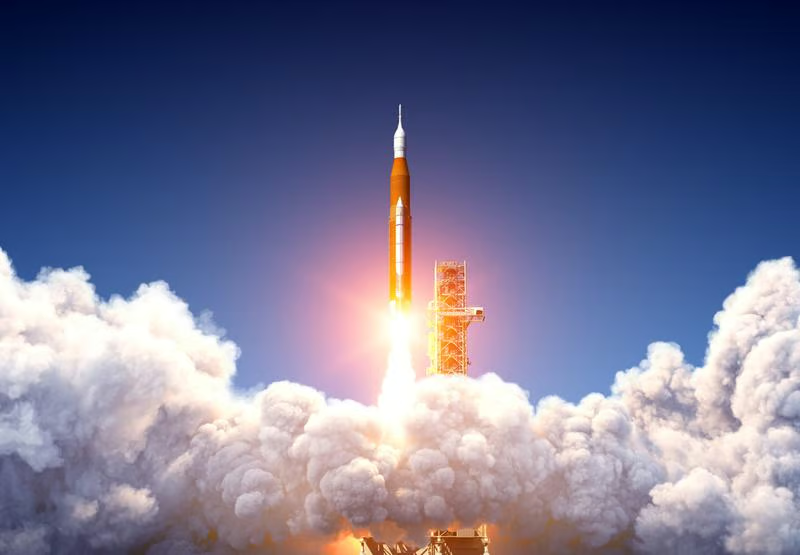
The day many investors have been waiting for has finally arrived. The much-ballyhooed initial public offering (IPO) of SpaceX (NASDAQ: SPCX) kicked off on Friday morning. Expectations were high heading into what has been billed as the biggest IPO of all time, and the stock made a splash on its debut.
Demand was high ahead of the event, with the SpaceX IPO more than four times oversubscribed, according to Bloomberg. Put another way, there was four times as much demand as shares available. The offering was priced at $135 per share, with plans to sell more than 555 million shares, raising $75 billion for the company. This would have valued SpaceX at a record $1.77 trillion, which would have made it the world’s ninth-most-valuable company.
Those estimates proved conservative, as SpaceX opened comfortably above the offering price. The stock began trading at 11:46 a.m. ET at $150, up about 11% from its IPO price. Here’s how the historic IPO played out.

Image source: Getty Images.
We have liftoff
Excitement was palpable ahead of SpaceX’s debut. CEO Elon Musk rang the Nasdaq opening bell remotely from Texas ahead of the historic offering. At the same time, CFO Bret Johnsen and President Gwynne Shotwell appeared at the stock exchange in New York to mark the occasion.
Retail investors had placed orders for more than $100 billion worth of stock. That was far more than the total shares available — and that didn’t even include institutional orders, which would receive the majority of the offering. The company was expected to allocate roughly 20% of the available stock to individual investors, meaning that most people who had submitted a request would receive far less than they had asked for.
That total percentage of stock allocated to retail investors may have been lower. Anecdotal reports suggest that some investors received between 3% and 7% of their request on popular trading platforms, including Charles Schwab, Morgan Stanley‘s E*TRADE, SoFi, Robinhood, and Fidelity.
That left many investors out in the cold, looking to buy SpaceX shares or buy more shares. As a result, many turned to the open markets when trading began, driving the share price even higher.

Space Exploration Technologies
Today’s Change
(24.88%) $33.59
Current Price
$168.59
Key Data Points
Day’s Range
$149.80 – $176.50
52wk Range
$149.80 – $176.50
Volume
11.4M
As I write this, SpaceX stock has climbed as high as $176.49, or roughly 31% above the offering price, though it’s currently up 27%, as of 1:36 p.m. ET. That values the company at more than $2.2 trillion, making it the world’s sixth-most-valuable company, ahead of Taiwan Semiconductor Manufacturing at $2.2 trillion and below Amazon at $2.5 trillion — though those rankings could change before the day is out.
What happens now?
To be clear, SpaceX has a lot to live up to. In 2025, the company generated revenue of $18.67 billion, up 33% year over year, largely driven by its Starlink satellite internet and mobile connectivity business, its only profitable business segment at this point.
However, SpaceX has signed two notable contracts in 2026, reaching agreements with Alphabet (GOOGL +1.04%) (GOOG +0.85%) and Anthropic to supply them with computing capacity from its xAI segment for $920 million per month and $1.25 billion per month, respectively.
The math suggests the company is on track to generate revenue of $45 billion in 2026, giving it a price-to-sales ratio of 45. While that’s much more reasonable than the multiple of nearly 100 a few weeks ago, the valuation still has a long way to go before most investors would consider it “reasonable.”
Charles Schwab is an advertising partner of Motley Fool Money. Danny Vena, CPA has positions in Alphabet, Amazon, and SoFi Technologies. The Motley Fool has positions in and recommends Alphabet, Amazon, and Taiwan Semiconductor Manufacturing. The Motley Fool recommends Charles Schwab and recommends the following options: short June 2026 $97.50 calls on Charles Schwab. The Motley Fool has a disclosure policy.
