
Earlier this month, the time-honored Dow Jones Industrial Average (^DJI +0.70%), broad-based S&P 500 (^GSPC +0.50%), and technology-fueled Nasdaq Composite (^IXIC +0.31%) all hit record-closing highs. Excitement for the artificial intelligence data center build-out has increased corporate growth forecasts and expanded valuation multiples to levels last seen in the late 1990s.
But Wall Street’s historic rally may not be as rock-solid as it appears. The May inflation report, published by the Bureau of Labor Statistics on June 10, revealed significant headwinds for the stock market.
While President Donald Trump doesn’t appear worried about inflation, and has even changed his tune about rising prices, a historically expensive stock market definitely cares — and that’s a big problem.
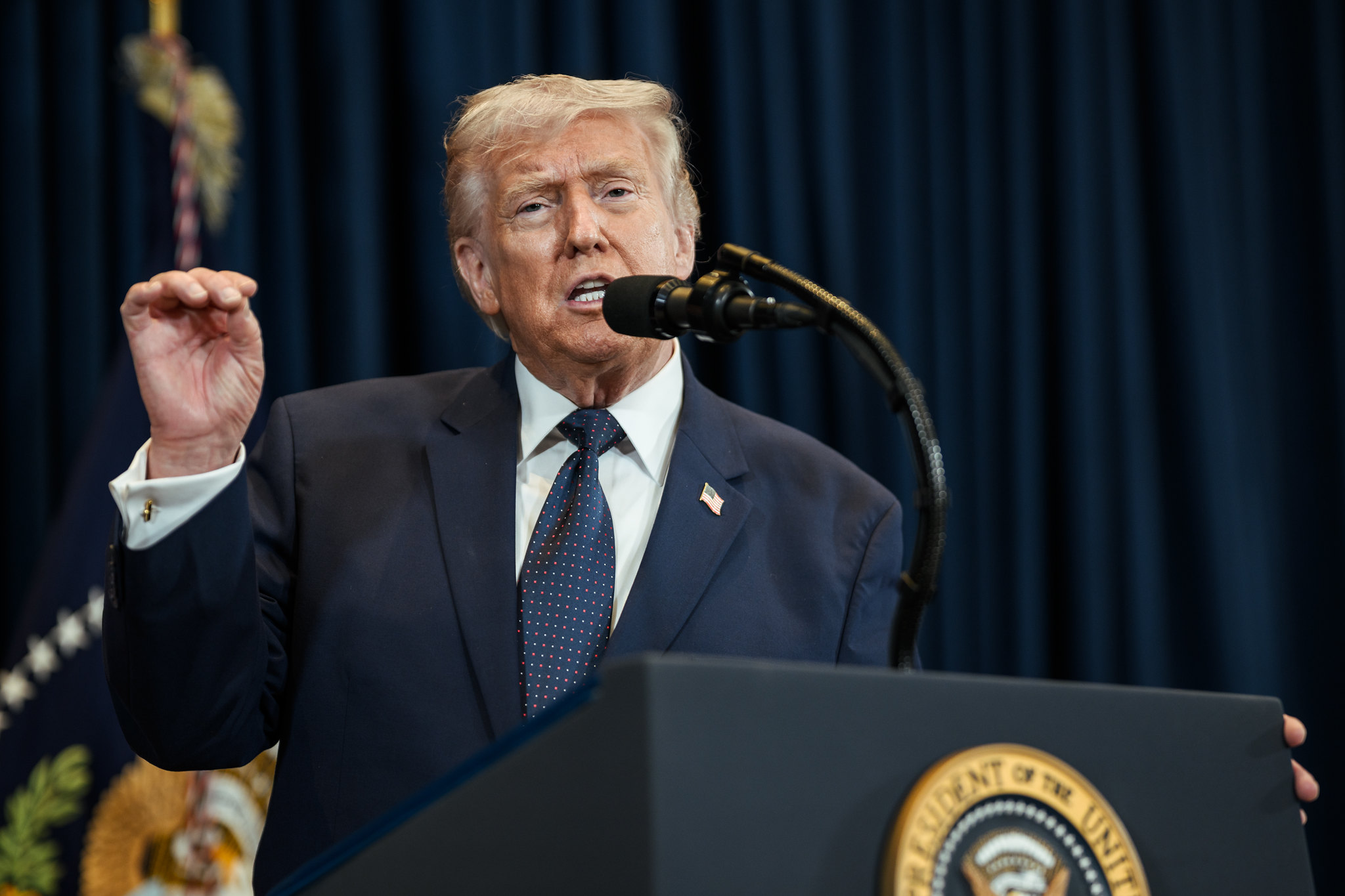
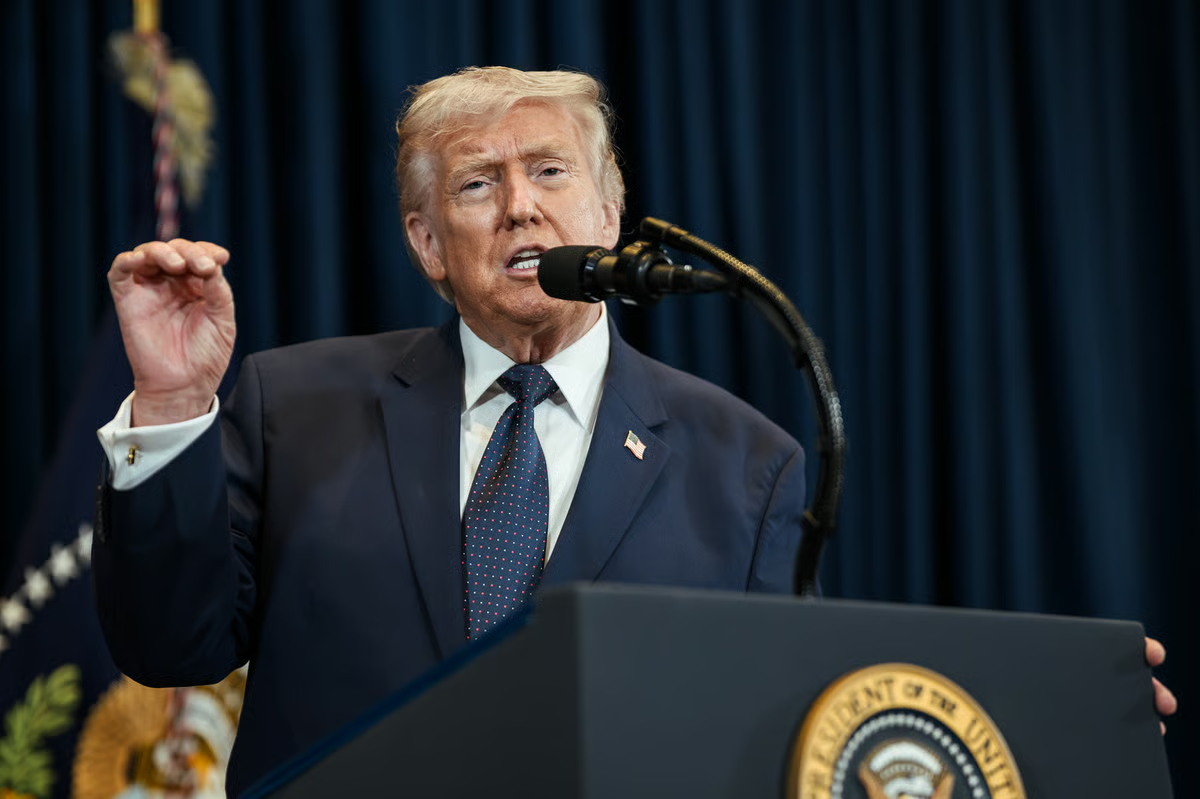
President Trump delivering remarks. Image source: Official White House Photo by Daniel Torok.
Inflation is soaring in the wake of the Iran war
Some degree of inflation is normal for a healthy economy. When businesses are firing on all cylinders, they should possess some level of pricing power for their goods and services. Since January 2012, the Federal Reserve has targeted a 2% long-term inflation rate.
While the Fed’s long-term target is an arbitrary line in the sand, there does come a point where inflation becomes concerning and/or harmful. We’ve arguably reached that point, courtesy of two decisions from President Trump.
The president’s decision to implement sweeping global tariffs has increased production costs for select domestic manufacturers. Adding duties to unfinished imported goods has modestly pushed up prices in the goods sector, according to now-former Fed Chair Jerome Powell.
However, the inflationary surge we’ve witnessed over the last three months is almost entirely tied to Trump’s decision to attack Iran. Not long after military operations commenced on Feb. 28, Iran shut down the Strait of Hormuz to most commercial vessels. This action effectively halted the flow of approximately 20 million barrels of petroleum liquids per day and quickly sent crude oil prices soaring. Anyone who’s visited a fuel pump over the last three months has felt the effects of the largest energy supply disruption in modern history.
The impact of the Iran war on the monthly U.S. inflation report has been pronounced. In February, trailing (TTM) 12-month inflation was only 2.4% and moving toward the Fed’s 2% long-term benchmark. By May, TTM inflation had jumped to 4.2%, representing a three-year high.
BREAKING: President Trump says “I love the inflation” and explains why after US CPI inflation rises to 4.2%.
Trump also announces that the US has been taking oil from Iran, including 22 ships of oil “last night.” pic.twitter.com/qPX9HNrsSm
— The Kobeissi Letter (@KobeissiLetter) June 10, 2026
Although Donald Trump often criticized his predecessor, President Joe Biden, for a rapid rise in inflation following the worst of the COVID-19 pandemic, he seems to have now changed his tune. Despite inflation hitting a three-year high in May, Trump had this to say in response to a question about the latest inflation number:
No, I love it. The numbers were great. You know what I really love? I love the inflation.
The president, who praised better-than-expected job growth in May, has been adamant that once the Iran war ends, crude oil and energy prices will quickly fall. But this is unlikely to be the case.
Typically, energy supply shocks endure several stages, with the inflationary effects on businesses often delayed by a few months. Once the impact of higher transportation and production costs filters into non-energy sectors and industries, inflation could prove far stickier than the president claims.

Image source: Getty Images.
A historically pricey stock market won’t share the president’s enthusiasm for inflation
The problem for Wall Street is that inflation is about far more than gas and diesel prices. It has real-world implications that can lead the Federal Open Market Committee (FOMC) to shift its stance on monetary policy.
Between September 2024 and December 2025, the FOMC lowered the federal funds target rate six times, bringing it to its current range of 3.5% to 3.75%. As of the FOMC’s April 29 meeting statement, the 12-person body responsible for setting the nation’s monetary policy still had its easing bias in place. But this could change as early as this coming week.
While the FOMC’s April meeting statement showed three members opposed the inclusion of the easing bias, the Fed’s April meeting minutes indicate that a majority of FOMC members want this statement removed. Shifting to a neutral bias would snuff out the possibility of additional rate cuts and be a first step toward possible rate hikes.
According to the CME Group‘s FedWatch Tool, the probability of an FOMC rate hike is soaring. There’s a greater than 71% chance of the FOMC raising interest rates by the December 2026 meeting — and that’s terrible news for the stock market.
JUST IN: The Fed is now projected to hike rates this year after a strong May jobs report.
53% chance. pic.twitter.com/9NvhjnxtwQ
— Polymarket (@Polymarket) June 5, 2026
When 2026 began, Wall Street and investors were expecting several rate cuts. But the May inflation report, coupled with the April Fed meeting minutes, makes clear that rate hikes, not cuts, are more likely.
This presents a serious dilemma for Wall Street. Whereas the S&P 500’s Shiller Price-to-Earnings (P/E) Ratio has averaged around 17.4 over the last 155 years, it came within a stone’s throw of reaching 43 earlier this month. This is the priciest stock market we’ve witnessed since the months leading up to the bursting of the dot-com bubble. In other words, investors expect perfection, and there simply isn’t much (if any) margin for error.
If the FOMC raises interest rates, financing the AI data center build-out becomes costlier. Higher interest rates also tend to put valuations into focus.
Ultimately, Donald Trump’s 180 on inflation may result in a corresponding 180 for Wall Street’s bull market.
