
This is turning out to be a history-packed year for Wall Street. Earlier this month, the time-tested Dow Jones Industrial Average (^DJI 0.09%), benchmark S&P 500 (^GSPC 0.05%), and growth-stock-powered Nasdaq Composite (^IXIC 0.24%) launched to fresh highs on the heels of artificial intelligence (AI) euphoria.
The last six weeks have also marked a rare succession at America’s foremost financial institution, the Federal Reserve. Jerome Powell served his final day as head of the central bank on May 15 (he remains on the Board of Governors), while President Donald Trump’s handpicked successor to Powell, Kevin Warsh, officially took over as Fed chair on May 22. He’s only the 17th Fed chair since the central bank’s inception in December 1913.
Prior to being confirmed as Fed chair, Warsh made clear that changes would be made under his leadership. Following his first Federal Open Market Committee (FOMC) meeting as head of the central bank on June 17, several of these changes were evident, including less forward guidance on interest rates. The FOMC is the 12-person body that’s responsible for setting the nation’s monetary policy.
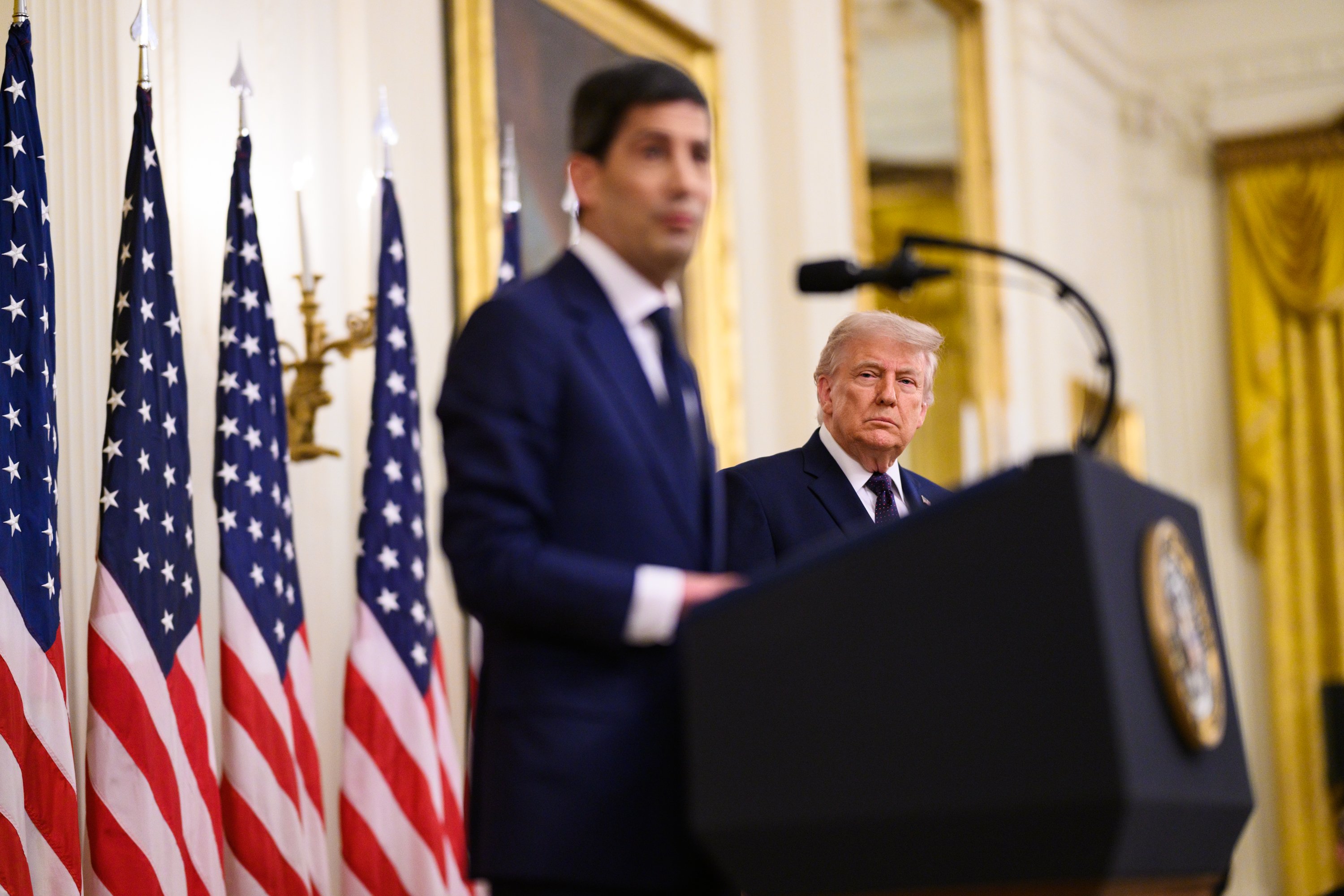
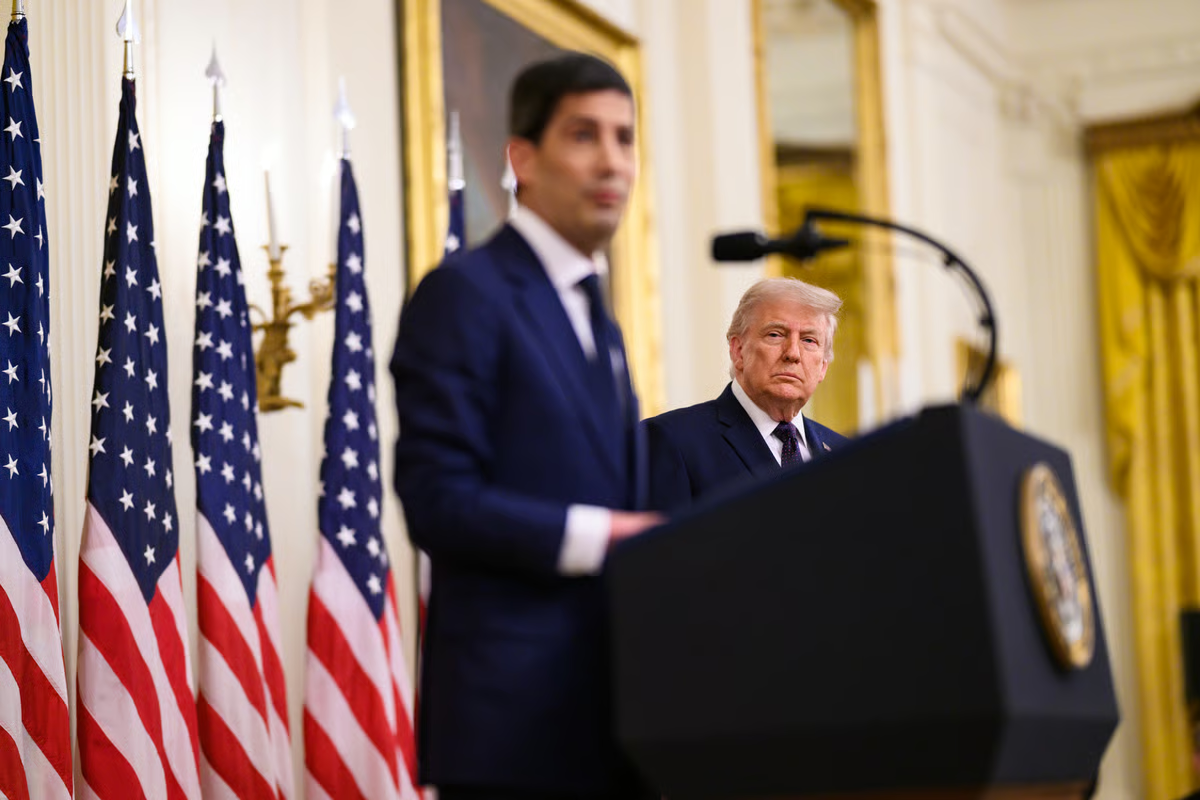
President Trump has been critical of the FOMC during his second term. Image source: Official White House Photo by Daniel Torok.
But Kevin Warsh’s first FOMC meeting in charge wasn’t all peaches and cream. Arguably, the Fed’s most vocal opponent over the last year, President Trump, took a jab at Powell’s successor and his colleagues over interest rates.
Donald Trump lays into the Warsh-led FOMC
Shortly after Trump’s inauguration for his second, non-consecutive term on Jan. 20, 2025, he began publicly criticizing Powell and the FOMC for not aggressively lowering interest rates. Although the FOMC reduced the federal funds target rate six times between September 2024 and December 2025 to the current range of 3.50% to 3.75%, Trump went on record as calling for rates to be slashed to 1% or lower.
While the president didn’t offer any specific reasons for this call, lower interest rates would provide the U.S. economy and federal government several benefits.
Lower borrowing costs would help fuel the partially debt-financed AI infrastructure build-out. Favorable lending rates can also encourage hiring, resulting in a lower unemployment rate. But perhaps most importantly, it would make it substantially cheaper to service America’s more than $39 trillion in national debt.
Q: Did you see the Fed is holding rates?
TRUMP: It’s alright. Whatever.
Q: And it looks like they might even raise them later this year
TRUMP: It could happen. I mean, it’s hard to believe. It just keeps a country down. pic.twitter.com/GzACiFoZob
— Aaron Rupar (@atrupar) June 17, 2026
However, Trump’s replacement for Powell didn’t deliver a rate cut in his first FOMC meeting as Fed chair. After the FOMC held rates steady on June 17, a reporter questioned President Trump about his thoughts on the decision and the possibility of policymakers raising interest rates this year. Trump’s response was an indirect jab at Kevin Warsh and his FOMC colleagues:
It’s all right. Whatever. It could happen… I mean, it’s hard to believe. It just keeps a country down… You know it’s so… it’s so unusual.
Trump likely believes that higher interest rates, or even keeping lending rates at their current level, will constrain corporate and consumer borrowing and weigh on the U.S. growth rate.
But it’s two of the president’s own decisions that have put Warsh and the FOMC into this difficult predicament.

Image source: Getty Images.
The probability of an FOMC rate hike is soaring
Though the president has pushed for lower interest rates, two of his own decisions have led to price shocks.
In April 2025, Trump unveiled sweeping global tariffs and higher reciprocal tariffs on countries deemed to have adverse trade imbalances with America. Despite the U.S. Supreme Court invalidating a majority of Trump’s tariffs in February 2026, the price stickiness of import duties continues to be felt in the goods sector.
The far more impactful price shock can be traced to the Iran war. Trump’s decision to attack Iran on Feb. 28 compelled the latter to close the Strait of Hormuz to commercial vessels. This disrupted the daily flow of approximately 20 million barrels of petroleum liquids, representing a fifth of global demand. The subsequent supply shock to crude oil sent fuel prices soaring.
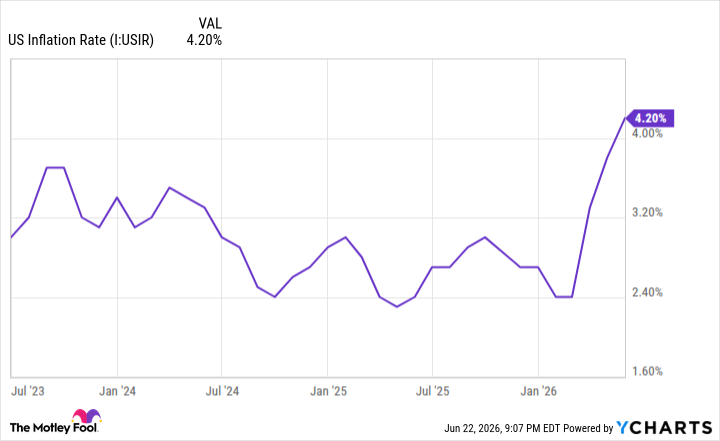
US Inflation Rate data by YCharts.
In the lead-up to Warsh taking over as Fed chair, trailing 12-month inflation jumped from just 2.4% in February to 4.2% in May — a three-year high.
Furthermore, the impact of energy supply shocks is often delayed for businesses. The fact that we’re not seeing Core Personal Consumption Expenditure forecasts decline implies that the inflationary impact of the Iran war is spilling into other areas of the economy beyond energy. In other words, above-average inflation may stick around longer than expected.
The historically hawkish Kevin Warsh and the 11 other voting members of the FOMC may be left with little choice but to raise interest rates to stabilize prices.
Warsh’s first FOMC meeting also coincided with the quarterly release of the dot plot (formally, the Summary of Economic Projections). The dot plot is an anonymous graph that shows where FOMC members expect interest rates to head in the coming years.
Very hawkish dot plot.
Nine out of 18 officials have at least one hike this year (and six of those 9 have *multiple hikes*).
Only one person has a cut this year, and one participant (presumably Warsh) didn’t submit an SEP
The statement gets a complete writethru from top to… pic.twitter.com/KRwatpTFOP
— Nick Timiraos (@NickTimiraos) June 17, 2026
While Warsh chose not to contribute to the latest dot plot, the other 18 members (not all of whom vote) offered their anonymous takes on interest rates. Nine of the 18 members expect interest rates to rise by the end of this year, with six forecasting two or more rate hikes. Since mid-May, the probability of a rate hike by the FOMC’s December 2026 meeting has essentially doubled to 89%, according to the CME Group‘s FedWatch Tool.
Higher interest rates are a significant worry for a historically pricey stock market. An increase in lending rates can slow the AI data center build-out and force investors to rethink the otherworldly valuations assigned to AI/tech stocks and the broader market.
Both Donald Trump and Wall Street may be in for an unpleasant surprise before the year ends, courtesy of Kevin Warsh and the new-look FOMC.