
You do not need a life audit to find out which part of your life is broken. You already know. You knew at 4 a.m. last Tuesday, doing the math on your father’s care, the client who has not paid, and the gym you have not seen since March.
A life audit is a structured review of the main areas of your life, work, health, money, relationships, purpose, in which you rate each one honestly and decide what to change. That is the standard definition, and it is where almost every version stops. You rate. You feel briefly clear. Then Wednesday arrives with its own agenda and the ratings sit in a notebook you will find next January.
The useful question is not how to score your life. You can do that in eleven minutes with a template off Pinterest. The useful question is what the audit is supposed to produce, and what you do on the Monday after.
What a life audit is, and what it usually turns into
Most life audits turn into an inventory with no decision attached. The standard version has you rate eight or ten categories from 1 to 10, usually career, finances, health, relationships, family, personal growth, fun, and physical environment, then draw the wheel and look at the dents. It produces a picture. Pictures are not plans, and that gap is where the exercise dies.
You have probably done a version of this. A coach’s worksheet, a Sunday-night journaling spiral, maybe a spreadsheet with weighted scores. It felt good. Naming things you have avoided for two years always feels good.
And then nothing moved. Not because you lack follow-through. You have twenty years of evidence that you follow through, or you would not have the career, the mortgage, or the people depending on you. Nothing moved because the audit handed you eight problems and no instruction about which to touch first, and eight problems is functionally identical to no list at all.
Your 1-to-10 ratings are not evidence
The numbers you write in those boxes are not measurements. They are impressions produced by whatever your attention happened to be on in the ninety seconds before you picked up the pen, and they move far more than you would expect.
The cleanest demonstration comes from Gallup’s daily poll of roughly 1,000 Americans a day. In a randomized split, asking people a few political questions right before the standard 0-to-10 life evaluation dropped their reported score by about 0.6 of a rung. That single change moved the number more than the entire measured decline in American well-being across the 2008 financial crisis, and one transition question pointing attention back to personal life erased almost all of it. [1]
Be careful with the popular version of this, though: that mood distorts your ratings, that you score your life lower on a rainy day. It did not survive testing. Nine replications with samples up to 401 people mostly found no effect of induced mood on life satisfaction ratings, [2] and matching daily weather records to ratings from more than a million Americans across five years, the weather predicted almost nothing. [3]
It is not your mood. It is what was in front of your mind. Rate “finances” ten minutes after opening a tuition bill and you write a 3. Rate it after a good invoice clears and you write a 6. Same finances.
So do not rate a feeling. Rate an incident. Next to every number, write one specific thing that happened in the last 60 days, with a date. “Health: 4, because I cancelled the physical twice, in May and June.” Now you have something you can act on, and something a future version of you can check.
A life audit is triage, not a scorecard
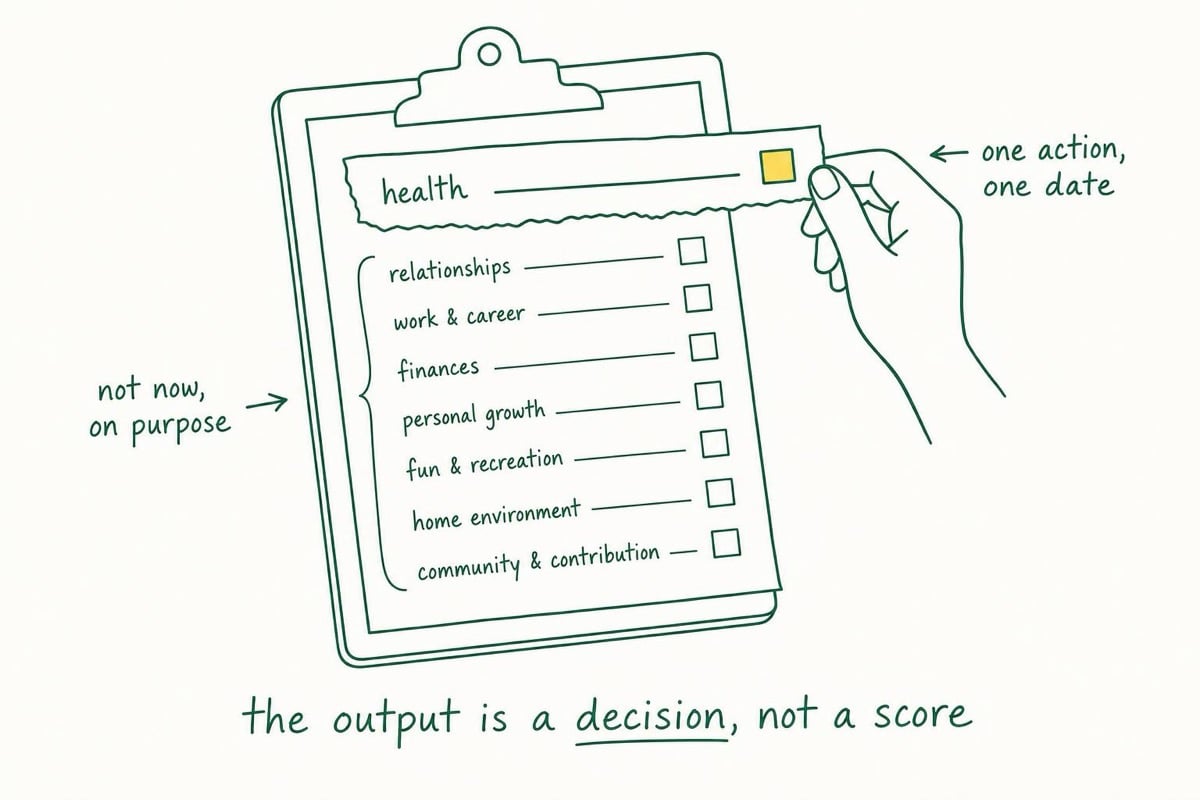
A life audit is triage. Its job is not to describe your life accurately, it is to decide what gets attention this quarter and what does not, and a triage that treats every case as urgent has not triaged anything. The output of a good audit is not a wheel. It is one domain, one action, one date, plus a written list of the things you are deliberately choosing not to fix yet.
That last part is what everyone skips, and it is what makes the rest work. The research on planning is unusually clear: a specific plan reliably helps people reach a single goal, and the same planning applied to several goals backfires, because it makes the difficulty of executing all of them salient, which undercuts commitment and drops goal success. [4]
There is a mechanism underneath it. Six studies on goal shielding found that activating a goal you are actually committed to automatically suppresses how accessible your other goals are, and that the suppression helps you pursue the one you picked. [5] Your mind runs one campaign at a time. An eight-item improvement list fights that design directly, which is a large part of why goal lists keep failing.
Leaving all eight open costs something too. A meta-analysis of 54 studies found goal conflict reliably associated with more psychological distress and lower well-being, [6] and the original work, two studies with 88 participants, found conflicted personal strivings predicted psychosomatic complaints a year later. [7] Small sample, undergraduates, correlational, so hold it loosely. The direction still matches what you feel every time you look at that list of eight.
Writing “not now” beside seven items is not resignation. It is the only way the eighth gets anything.
Start with the load-bearing domain, not the lowest score
The obvious move after scoring is to attack the worst number. We think that is wrong most of the time. This is the one claim here we are making from pattern rather than from a study, so treat it as an operating rule and test it against your own life.
The lowest score is usually a symptom of another domain quietly carrying load for everything else. Sleep is the classic one. So is an unresolved money question. Fix the load-bearing domain and two or three other scores move without you touching them. Fix the lowest score directly and it springs back within a month, because whatever was depressing it is still running.
Ask one question of your list: if this area got measurably better in six weeks, which other areas get easier? Whatever produces the longest list is your load-bearing domain, and it is frequently not your worst score.
Dana, 48, scored career a 3, exactly what she expected. Health came out a 6, which felt fine. But the 3 traced back to arriving at 9 a.m. already spent, which traced back to a 6-hour average night. Attacking “career” meant a resume refresh and coffee meetings she had no energy to be good in. She went after sleep instead, one thing, for a quarter.
Greg, 52, got the opposite answer. His lowest score was fitness, but his load-bearing domain was money: an unopened stack of statements about his mother’s care costs, generating a background hum of dread for eight months. Two hours with a spreadsheet and one phone call did more for his sleep, his temper and his gym attendance than any training plan had. If your dread has an address, go there first, and our guide to getting your finances in order in your 40s is where to take it.
How to run a life audit in one sitting
Ninety minutes, one sitting, paper. Not a weekend retreat, not an app, not a rolling document you revise for three weeks. The point is to reach a decision before your enthusiasm expires, so give it four passes and a hard stop.
Pass one, 20 minutes: inventory with receipts. Eight domains is plenty: work, money, health, partnership, family, friendships, growth, home. Rate each 1 to 10, and beside every rating write one dated incident from the last 60 days that justifies it. No incident means the rating is a mood, so leave the box blank.
Pass two, 20 minutes: map the load. For each low-scoring domain, ask what gets easier elsewhere if it improves. Draw the arrows. You want the domain with the most arrows leaving it, not the smallest number.
Pass three, 20 minutes: triage. Circle one domain. Write “not now” beside every other one, in ink, including the ones that hurt. This will feel irresponsible. It is the responsible part.
Pass four, 20 minutes: one action, one date. Turn the circled domain into a single action specific enough that a stranger could tell whether you did it, with a when and a where. Not “sleep better.” Instead: “Phone goes on the kitchen counter at 10:15 p.m., starting Monday.”
That last move has the strongest research base of anything here. It is called an implementation intention, an if-then plan naming when, where and how before the moment arrives. [8] A meta-analysis of 94 independent tests covering more than 8,400 people put the effect on goal attainment at d = 0.65. [9]
Now the correction, because it matters. The same authors’ 642-test update puts the range at 0.27 to 0.66, so 0.65 is the ceiling, not the average, [10] and a pooled analysis of 13 randomized trials on adult physical activity found just 0.15, with a confidence interval from -0.01 to 0.31 that crosses zero. [11] An if-then plan beats intention alone. It does not do the work for you, and anyone quoting the 0.65 without the 0.15 is selling something.
Size that action for your worst week, not your best one. That is the whole argument in consistent habits in midlife, and it applies here. Then one last line before you close the notebook: the date of your next audit, at the top of the page. That is what separates a life audit from a mood.
Two versions of the same Sunday
The standard version first. Dana clears the table at ten on a Sunday in October, makes the coffee, prints the wheel. By eleven she has eight numbers, three of them under 5, and a page of notes about how she has let things slide. The mix of clarity and shame feels like progress, so she resolves to fix her sleep, her fitness, her side project, her sister, and her spending. Monday she is back in the same 6-hour nights, and the notebook goes in the drawer with last year’s.
Now the triage version. Same table, same coffee, same eight numbers, but every number has a dated incident next to it, so “family: 5” reads “family: 5, because I have not called my sister since her birthday in June.” At 10:40 she maps the arrows and finds sleep sitting under work, under temper, and under three-quarters of what she dislikes about herself at 4 p.m. She circles sleep and writes “not now” beside seven items. It stings, especially beside her sister’s name. By 11:15 she has one sentence, phone on the kitchen counter at 10:15 p.m. starting Monday, and one date underneath it, February 8, for the next audit.
What makes the second version work is not the sleep. It is that on the Wednesday in November when she is tired and irritable, exactly one question is in front of her, and she can answer it. Not “am I fixing my life?” Just “did the phone go on the counter?” Yes-or-no questions are the only kind that survive a bad week. Same mechanic as staying consistent with goals and our longer argument on how to be disciplined and consistent: spend the decision once, not every morning.
How often to run a life audit
Twice a year for the full ninety minutes, plus a twenty-minute check each quarter on the single action you chose. Straight answer: we could not find a study establishing a correct interval, and anyone quoting you one is guessing. What we can tell you is how each interval fails.
Annual audits fail on latency. Twelve months is long enough for a domain to go from strained to badly damaged before the review catches it, and it invites the January ritual where the audit is a resolution wearing better clothes.
Monthly audits fail worse. Re-scoring your whole life every four weeks keeps all eight domains permanently open, which is exactly the goal-conflict state the research above ties to distress and stalled action. It also gives you noise, because nobody can honestly answer “has my health improved since March 3rd?”
Twice a year is long enough for real change to show up and short enough to catch a fire in the season it starts. Put both dates in the calendar now, and pick ordinary weeks: not January 1, not your birthday, not the week after a funeral. An audit run in an emotional week produces emotional numbers, which is the problem we started with. If you are mid-upheaval, our guide to the midlife transition is the better place to start and the audit can wait a month.
“I already know all this. Why write it down?”
Because you do not know it all at once. You know each piece separately, at different hours, under different amounts of stress, never in a form you can compare against last quarter.
Greg made exactly this objection. He could have told you his fitness score and his money score without a worksheet. What he could not do, until both sat on one page, was see that they were the same problem. That is what the page buys: not new information, but the relationship between things you already knew.
It also buys a record. Six months from now, “my health is bad” will feel identical whether it improved or not, because feelings do not keep receipts. A dated line from August does. And the real objection is not “I know this already.” It is “what if I write it down and nothing changes again.” Fair. Write it down anyway, with one action instead of five, and in February you will know which it was. If that fear is loud right now, feeling lost in your 40s covers the ground underneath it.
Your next 90 minutes
Pick a Saturday in the next three weeks. Ninety minutes on the calendar, a paper notebook, four passes: rate with receipts, map the load, circle one domain, write one action with a when and a where. Then date the next audit at the top and close the book.
Your life audit is not the score. It is the one sentence you leave the table with, and the seven things you gave yourself permission to leave alone until February. Our midlife reset guide covers what to do once you know which domain you picked, and life planning in your 50s takes the same logic past the next quarter.
Frequently Asked Questions
How do you do a life audit?
Run four passes over ninety minutes. Rate eight life domains from 1 to 10, writing a dated incident from the last 60 days beside each rating. Map which domain, if improved, would make the others easier. Circle that one and write “not now” beside every other domain. Then turn the circled one into a single action with a specific when and where, and set the date of your next audit before you close the notebook.
What are the categories in a life audit?
Eight is enough: work, money, health, partnership, family, friendships, personal growth, and home environment. Longer lists feel thorough and make triage harder, because every category you add competes for the single decision the audit exists to produce. If a category has not generated a real incident in the last two months, drop it rather than rating it.
How often should you do a life audit?
Twice a year for the full version, plus a twenty-minute quarterly check on the one action you chose. No research establishes a correct interval, so this is a judgment call about failure modes. Annual reviews let a problem run twelve months before you see it. Monthly reviews keep every domain permanently open and return noise, since most real change is invisible over four weeks.
What if every area of my life scores low?
That is common at 45, and it usually signals load rather than eight separate failures. When everything scores low, one domain is almost always draining the rest: sleep, an unresolved money question, or a conversation you have avoided. Find the domain with the most arrows leaving it, work only on that, and re-rate in six months.
How long does a life audit take?
Ninety minutes in one sitting. Longer and you are editing rather than deciding, which is how audits become documents nobody acts on. With thirty minutes, skip the inventory: name the domain that has cost you the most sleep this quarter, write one action with a when and a where, and set a date to review it.