
You are five weeks in. The morning walk, the weights, the twenty minutes with the money spreadsheet you have been avoiding since 2019. You have not quit, which is more than the last three attempts managed.
But it still costs you something every single morning. That’s the part nobody warned you about.
So you go looking for a number. How long until this stops being a decision you have to make?
Here is the short answer, and then the more useful one. Habits take a median of 59 to 66 days to feel automatic, and the spread around that median is enormous: a 2024 systematic review of 20 studies covering 2,601 people found study means running from 106 to 154 days and individual times running from 4 days to 335. [1] Twenty-one days was never in the data.
The more useful answer is that you’re not really asking a trivia question. You’re asking how long before this stops falling apart.
The honest number, and the range that should worry you
The best current evidence puts habit formation at roughly two to five months for most health behaviours. The famous 66-day figure comes from one 2010 study at University College London, where 96 volunteers repeated a self-chosen daily behaviour in the same context for 12 weeks. The 2024 review quotes it directly: the median time to reach 95% automaticity was 66 days, with a range of 18 to 254 days. [1]
Three things get left out every time that number is quoted, and all three matter to you.
The study ran 84 days, which makes 254 a modelled projection past the end of the observation window rather than something anyone sat and watched. Even at the 84-day mark, about half the participants had not reached an automaticity score high enough to count as a habit. And the volunteers were university-affiliated adults with a mean age of 27, not people running a household and a P&L at the same time. [2]
None of that makes the finding wrong. It makes it an order of magnitude rather than a delivery date. Two months is the honest planning assumption, and four is not unusual. If your last few attempts died around week four, you were not failing a 21-day test. You were quitting inside a normal timeline, which is the pattern underneath most goals that keep collapsing on you.
Where 21 days came from, and why it was never about habits
The 21-day rule traces to a plastic surgeon. In the preface to Psycho-Cybernetics (1960), Maxwell Maltz wrote that it takes about 21 days for a patient to get used to a new face after surgery, about 21 days for a phantom limb to fade, and about three weeks in a new house before it starts to seem like home. His conclusion was about self-image: “it requires a minimum of about 21 days for an old mental image to dissolve and a new one to jell.” [3]
Notice what he was not measuring. Getting used to something is habituation. A habit is an automatic response fired by a cue. Different mechanism, different literature, different clock. The habit researchers who traced this are blunt about the swap: the 21-day claim “appears to have originated from anecdotal evidence of patients who had received plastic surgery treatment and typically adjusted psychologically to their new appearance within 21 days.” [4]
Maltz’s observations came from his own clinical impressions, not from trials or cohorts. [5] Sixty-six years later it is printed on wall calendars and sold as a challenge.
The number is not the answer. The shape of the curve is.
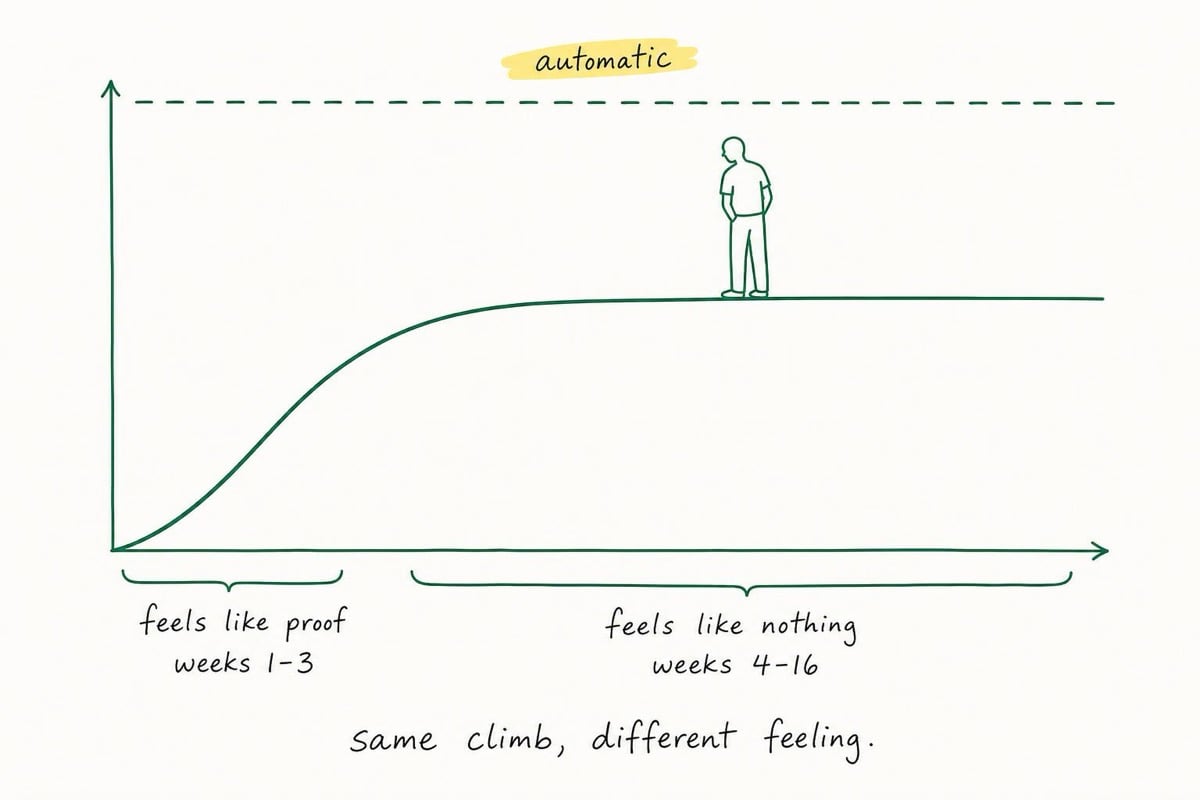
Automaticity does not switch on at a threshold. Daily ratings of habit strength in the UCL cohort “showed an asymptotic increase, with an initial acceleration that slowed to a plateau after an average of 66 days.” [4] Steep at the start, then flatter and flatter as it approaches a ceiling. Which means most of the relief you can feel arrives early, and most of the durability arrives late, in weekly gains too small to notice.
So here’s our contrarian read. The 66-day figure is the least useful true fact about habits.
Useful enough to kill the 21-day myth, useless for the thing you actually need, because the moment a routine stops feeling hard and the moment it can survive a bad week are two different moments, and they can be two months apart. Week three feels like proof. That is the steep part of the curve doing its work, and it is exactly why the 21-day rule survives contact with real life: it describes something real, just not the thing it claims to.
Then week seven arrives. Nothing feels like it is improving, because on a flattening curve almost nothing is, in any way you can perceive. That is also where half of the UCL volunteers still sat below habit strength at the end of twelve weeks, having done the work every day.
The mistake is not impatience. The mistake is using “does this feel automatic yet” as the progress meter, when that feeling saturates long before the habit is durable. Understanding what is happening underneath while the feeling flattens out helps, but what you really need is a different gauge for the middle months.
What decides where you land in that range
Three things move the timeline more than effort does: whether the behaviour fires from the same cue in the same context every time, how complicated the behaviour is, and where you place it in the day. Get all three right and you move toward the fast end of the range. Leave the cue floating and the behaviour ambitious, and you get the 254-day version or you get nothing.
The same cue, in the same place, every time
Repetition alone does not build automaticity. Repetition in a stable context does. “Mere repetition of a simple action in a consistent context leads, through associative learning, to the action being activated upon subsequent exposure to those contextual cues.” [4]
This has been tested directly rather than just observed. In a six-week experiment, students building a new study routine were split so that one group kept the room and time fixed and the other was made to vary them, and the finding was replicated in field data covering 308 habits and 2,368 repetitions from 218 users of a habit app. Context stability predicted both higher automaticity and better follow-through on the repetition goal. [6] Those were study habits among students, so read it as the mechanism rather than as a promise about your gym.
In practice this is the difference between “in the mornings” and “after I pour the first coffee.” One is a hope. The other is a trigger, which is the whole logic behind attaching a new behaviour to an existing one.
How complicated the thing is
Simple beats elaborate, and the gap is not small. In the UCL cohort, “automaticity strength peaked more quickly for simple actions (for example, drinking water) than for more elaborate routines (for example, doing 50 sit-ups).” [4] Participants chose their own behaviours, so complexity was not assigned by the researchers. Treat the direction as solid and the size as suggestive.
Complexity also interacts with the cue problem. Across 459 people and 25 different behaviours, complex behaviours were less likely than simple ones to become automatic when context stability was low. [7]
Read those two findings together and the standard midlife plan looks worse than it felt. A 45-minute gym session, whenever the calendar allows, is the elaborate behaviour and the unstable cue at the same time. That combination is the one the evidence says will take longest, which is why we keep arguing for a floor you can hit on your worst day instead of a plan built for your best one, and for picking the one behaviour that drags others along with it rather than four at once.
Where you put it in the day
Forty-eight people were randomly assigned to do the same stretch either on waking or before bed, then tracked for 90 days. The modelled curves put the morning group at automaticity around 106 days and the evening group at 154, with cortisol level at the time of performance a significant mediator. [8] Small sample, student volunteers, and both day figures are extrapolated past the observation window, so this is a lean, not a law.
Placement inside a routine matters too. In a flossing study, 50 people were split between flossing before brushing and flossing after. Anchoring the new behaviour after the established one produced stronger automaticity at four weeks, and the advantage was still there at the eight-month follow-up. [9]
Earlier in the day, immediately after something that already happens without your involvement. That’s the cheapest speed-up available.
How to hold a routine for four months when it still feels like work
The middle months are the whole problem. You are past the early payoff, nothing feels like it is improving, and the behaviour still takes a decision. Three moves carry that stretch, and none depends on motivation, which is the resource you have least of at week nine. The longer version of that argument sits in discipline versus consistency.
Write the if-then line, not the intention. An implementation intention names the situation and the response: if it is 6:40 and the coffee is poured, then shoes on and out to the corner and back. Across 94 studies and more than 8,000 participants, forming one produced a medium-to-large effect on goal attainment over simply holding the goal (d = 0.65), with the effect on not getting derailed once underway (d = 0.77) larger than the effect on getting started (d = 0.61). [10] [11] Derailment is exactly your week-nine risk.
Track the action, not the outcome. A meta-analysis of 138 studies and 19,951 participants found that prompting people to monitor progress raised goal attainment (d+ = 0.40), and buried in it is the instruction that matters: monitoring the behaviour moved the behaviour (d+ = 0.79), while monitoring outcomes barely moved outcomes (d+ = 0.14). Effects were larger when progress was physically recorded or reported to someone. [12] Log the walk. Do not log the scale. A paper calendar works; so does any of the habit trackers we have tested.
Decide the missed-day rule before you miss the day. Skipping a single opportunity did not seriously impair habit formation in the UCL data: “automaticity gains soon resumed after one missed performance.” [4] The damage isn’t in the missed day. The damage sits in what you decide it means. Relapse researchers describe this directly: people who read a slip as evidence of a stable personal flaw, the “I have no willpower” reading, are the ones most likely to abandon the attempt entirely. [13] That work comes from the addiction literature, so applying it to a skipped walk is an extension by analogy, not a proven transfer.
One honest limit: the missed-day finding covers single misses. A missed week is a different question, and this evidence does not answer it. Which is why the rule we use is mechanical. One miss is data. Two in a row is a scheduling problem, and it gets solved on the calendar, not in your character. We built a whole recovery loop around that distinction.
What this looks like on an actual calendar
Greg is 49 and runs a six-truck HVAC company. He wants to be lifting three times a week by winter. The version that failed twice: 45 minutes at a gym eleven minutes away, “after work, most days.”
The version he is running now: a kettlebell in the mudroom, ten minutes, immediately after he pours the first coffee at 5:50, every weekday. One cue, one place, one time, a behaviour small enough to do on his worst day.
Weeks one to three felt great. Week six felt like nothing at all. He stayed because he had been told in advance that week six would feel like nothing, and because he was logging sessions instead of weight. Week ten was the first time he reached the mudroom before he had decided to. Week sixteen he did it in a hotel, badly, with no kettlebell, and it counted.
Carla, 44, a nurse manager, put hers at the other end of the day and paid for it. Twenty minutes of reading, “before bed,” which is a time that does not exist in a house with teenagers. Four weeks, six sessions. She moved it to the fifteen minutes after she parks in the driveway, a moment that happens every working day whether she plans it or not. Same behaviour, real cue. It stuck.
Neither of them felt anything at day 66. Greg’s estimate is that lifting stopped being a decision somewhere around day 90, and he noticed weeks after the fact.
But you have restarted this five times already
The restart count is not a verdict on your capacity. It usually reports the same three things: the cue was a time of day rather than an event, the behaviour was sized for the person you intend to be rather than the week you are in, and you graded yourself on how automatic it felt at week four.
And if the quiet worry is that you are too old for this, the evidence runs the other way. In a four-week routine-formation study, 68 adults aged 18 to 29 were compared with 63 adults aged 65 to 86. The older group stuck to the daily routine better and reported higher automaticity, despite measurably poorer working memory, prospective memory, task switching and goal-directed control. [14] Automaticity there was self-reported and the behaviour was one trivial daily action, so hold it loosely. Researchers reviewing habit formation in older adults reach the same place: more self-regulation and more regular days help rather than hinder. [15]
What you have that a 27-year-old volunteer does not is a life with fixed edges in it. School runs, standing meetings, the drive home. Every one of those is a stable cue, and stable cues are the scarce ingredient. That’s the advantage hiding inside a midlife schedule that feels like a constraint.
One thing to do today
Take the routine you are currently failing at and cut it to the version you could do on your worst day this year. Then find the event it will hang from, something that already happens without your involvement, and write one line on paper: if [event], then [behaviour]. Under it, write your restart rule, in advance, while you are calm.
Then stop checking whether it feels automatic. Check whether the cue fired. Come back to the feeling question in March, by which point you will have something that holds without you watching it.
Frequently Asked Questions
What is the 3-3-3 rule for habits?
Ask five sources and you get five versions: three days, three weeks, three months; or three habits, three times a day, three minutes each. We could not find a published study behind any of them. The variables the research does support are unglamorous by comparison: repeat the behaviour in a consistent context, keep it simple, and expect roughly two to five months rather than three weeks.
What is the 21 90 rule?
The claim that 21 days makes a habit and 90 days makes a lifestyle. The first half is Maxwell Maltz’s 1960 observation about surgical patients adjusting to a new face, which was never a habit finding, and the 90-day extension is a later mutation of the same anecdote. The measured medians sit at 59 to 66 days, with wide individual variation.
What are the 4 stages of habit forming?
Cue, craving, response, reward, as set out by James Clear. That is a trade framework rather than a research finding, and the craving step in particular is his addition. The academic account is narrower: a response repeated in a stable context with reward, until perception of the relevant context cues automatically activates the mental representation of the habitual response.
Can you form a habit in 14 days?
For a very simple, strongly cued behaviour, yes, at the fast end. The fastest individual times on record in the review literature run to 4 days, and the UCL study’s fastest participant hit the plateau at 18. A glass of water after breakfast can automate in a fortnight. A 45-minute workout at variable times will not, and planning around 14 days is how people conclude they have failed when they are on schedule.
Does habit formation get slower after 40?
No evidence says so. The one direct age comparison found adults aged 65 to 86 adhered better to a new daily routine and reported it becoming automatic sooner than adults under 30, despite worse scores on the underlying cognitive measures. No study has measured days-to-automaticity for a 40 to 60 band specifically, so nobody can quote you a midlife number. What changes with age is not your capacity to automate. It is how many competing claims land on the same hour.