
You took the two weeks. You slept past six, you stopped checking email somewhere around day four, and by the last morning you felt close to normal. Then you went back. Three days in, the tightness was sitting exactly where you left it.
So you go looking for the stages of burnout recovery, and every page hands you the same two things: a list of the stages of getting burned out, and a timeline in weeks. Neither answers what you asked, which is where am I now and what happens next.
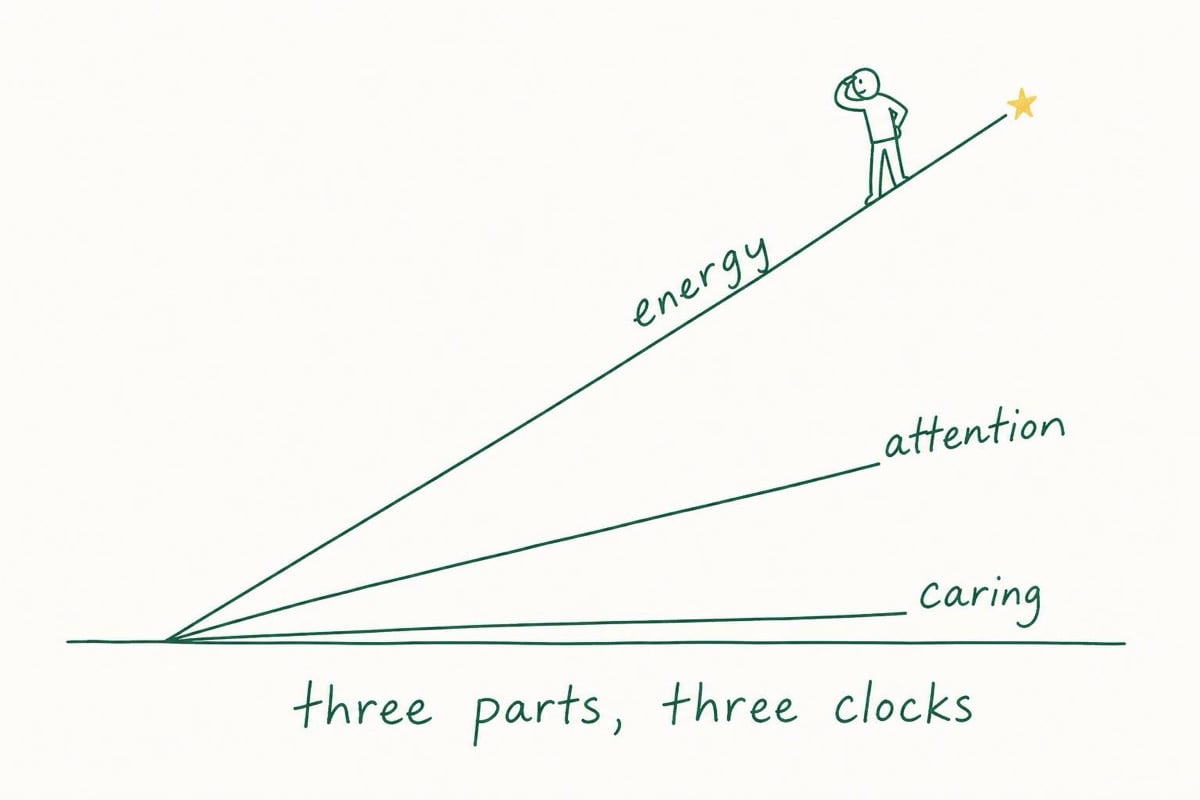
Burnout recovery stages are the phases of getting your capacity back, and they are not measured in weeks off. They are marked by which capacity has returned. Energy comes back first. Attention comes back later, on a slower clock of its own. The sense that any of it matters comes back last, and only if something about the work actually changed.
Why the two weeks off didn’t hold
Time off works. It just does not do the job you hired it for. Vacation lifts health and wellbeing for real, and the lift reverses once you resume work: the first meta-analysis on the question pooled seven studies and put the gain at d = +0.43 and the fade at d = -0.38. [1]
The timeline is unkind. Seventy-six clerks were measured before a company shutdown, during it, and twice after. Burnout was already partway back up three days after the return, and all the way back by three weeks. [2]
A longer trip does not fix it either: in 54 employees on 23-day summer vacations, measured ten times, wellbeing peaked on the eighth day and was back at baseline inside the first week of work. [3] In fairness to the beach, a 2025 meta-analysis of 32 studies argues the benefit is larger and slower to fade than the older numbers say. [4] The size is contested. The direction is not.
Rest is one stage of recovery. It was never the whole of it, which is why the step-by-step burnout recovery protocol starts with an ordinary Tuesday rather than with a trip.
Burnout has three parts, and they don’t heal together
A recovery timeline in weeks tells you nothing because burnout is not one thing losing charge. The World Health Organization defines it by three dimensions: energy depletion or exhaustion, increased mental distance from your job or cynicism about it, and reduced professional efficacy. [5] Three parts, three speeds.
Christina Maslach and Michael Leiter, who built the inventory most of this research runs on, argue each dimension answers to a different remedy: exhaustion to workload and to sleep, exercise and nutrition, cynicism to community and values, efficacy to recognition from the people you work with. [6] Different levers, different clocks.
The measured gap is real. A meta-analysis of 35 years of burnout intervention research found exhaustion moved most (effect size .20, rising to .34 at a second follow-up), cynicism moved less (.15, then .18), and reduced efficacy did not move significantly at all (.08, 95% CI -.03 to .19). [7] A 2024 meta-analysis of intervention trials in resident physicians found the same ordering: emotional exhaustion down (d = -0.25), depersonalization down less (d = -0.18), personal accomplishment not significantly changed. [8]
Two caveats. Both are intervention studies in narrow occupations, so what they establish is that the dimensions respond to treatment at different rates, not that they spontaneously heal in a fixed order. And efficacy is measured in fewer studies than the other two, so some of its lag is a measurement gap rather than a clinical fact.
It still lands where anyone who has been through this recognizes. You get your energy back, decide you are done, and then notice you still do not care.
Stage 1: You stop pretending
The first stage is not rest. It is the moment you stop performing normal and let something be visibly dropped, because nothing improves while you are still carrying the full load and covering for it. The marker of stage 1 is not that you feel better. It is that one real thing has come off the pile and stayed off.
Waiting to feel better first is how people spend a year at stage zero. A clinical review of stress-induced exhaustion disorder is blunt about it: do not wait for an asymptomatic state before starting rehabilitation and the return to work. [9] You act while you still feel terrible, and the feeling follows later.
The other half of stage 1 is mental. Sabine Sonnentag and Charlotte Fritz separate off-hours recovery into four experiences: psychological detachment, relaxation, mastery and control. Across 930 people, detachment, meaning actually not thinking about work, showed the strongest relationship of the four with impaired wellbeing. [10] A meta-analysis of that literature puts the correlation with exhaustion at around r = -0.35 to -0.38, the strongest health association in the set. [11]
Sitting on the couch with your laptop shut and the project running in your head is not detachment. It is the same shift, unpaid.
One honest limit, from 316 samples and 99,329 people: detachment lowers exhaustion and negative affect, and does not appear to raise engagement, performance or creativity. [12] Switching off buys less exhaustion, not a better quarter.
Stage 2: The energy comes back first
Stage 2 arrives when you wake up not already tired. Not energetic. Just not starting the day at a deficit. This is the fastest-moving dimension and the one every intervention shifts first, which is why it fools people into thinking the whole thing is over.
Sleep is where the loop lives. In 1,356 employed adults followed for about 18 months, burnout predicted new cases of insomnia (OR 1.93, 95% CI 1.45 to 2.58) and insomnia predicted new cases of burnout (OR 1.64, 95% CI 1.30 to 2.08), each after controlling for depressive symptoms, neuroticism, BMI, age and sex. [13] The arrow runs both ways, so sleep is not only a symptom to wait out.
It also gates the rest of the climb. Fifty-nine clinically burned-out employees on sick leave were tracked by diary and followed for six months. Symptoms fell and 37% returned to work fully, but those who benefited poorly from sleep at the start still had higher exhaustion at follow-up, and trouble falling asleep predicted failure to fully resume work. [14]
Movement helps, at a size worth stating accurately. A randomized trial put 288 health care workers, mean age 41, on a 12-week at-home program of four 20-minute sessions a week. By week 12 the exercise group showed reductions in emotional exhaustion (effect size -0.39) and cynicism (-0.33). [15] Note the dose: 80 minutes a week, at home. Note the adherence too, which fell from 54.9% hitting that target at week two to 23.2% by week twelve.
And the counterweight, because one trial is not a field: a meta-analysis pooling four randomized trials of exercise therapy in people with burnout, 248 participants total, found a combined confidence interval running from -0.41 to 0.09, which is no clear difference from control. [16] Exercise moves exhaustion. It does not erase burnout, and anyone selling it as the cure is selling. If you are starting from years of sitting still, our guide to starting to exercise at 50 is written for the joints and the schedule you actually have.
Ellen, 51, an operations director, hit stage 2 about seven weeks after handing two accounts to a colleague. She stopped needing the 3 p.m. coffee, read that as the finish line, and took a third account back. By October she was worse than she had been in June.
Stage 3: Your attention comes back on its own clock
Stage 3 is when you can read a long document once and know what it said. It lags well behind energy, and it is the stage nobody warns you about, which is why so many people conclude they are losing their edge permanently.
The brain fog is measurable, not imagined. A meta-analysis of 17 studies covering 730 people with clinical burnout and 649 controls found impairment in episodic memory (g = -0.36), working memory (g = -0.36) and executive function (g = -0.39), growing worse as the task demanded more attentional control. [17]
It also outlasts the feeling of being better. Patients retested an average of three years after first seeking care for stress-related exhaustion, mean age 49, still performed significantly worse than controls on speed, attention and memory, with no major change over that period, even though half of them no longer reported mental health problems. [18] The clinical review puts it plainly: cognitive impairment may last several months or even years. [19]
Hold that loosely: small samples from Swedish specialist stress clinics, a more severe group than a tired manager who has never seen a doctor. And when people who went through it were interviewed six to ten years later, what they described was not a fixed deficit but a stress-sensitive one. Capacity had improved, and it still moved with current workload and sleep. [20]
So stop scheduling around the person you were. One hard-thinking block a day, protected, early, everything else behind it. This is where rebuilding a routine that holds in midlife matters more than any burst of ambition, and where treating a missed day as data rather than failure stops the whole thing collapsing on the first bad week.
If the fog is severe, if it comes with persistent low mood, or if you cannot function at work or at home, that is a doctor’s question rather than an article’s. Burnout overlaps with depression and with several treatable medical conditions, and telling them apart is clinical work.
Stage 4: Caring comes back last, and only if something changed
Stage 4 is when the cynicism lifts and the work feels like yours again. It is the slowest of the three, and the one that does not respond to anything you do to yourself in the evenings.
Look again at those intervention numbers. Across 35 years of burnout interventions, the efficacy dimension did not move significantly. [7] That is a dimension that ignored decades of programs aimed at it. Be careful with the obvious conclusion, though, which is “so change the job.” In the resident physician meta-analysis, organizational interventions showed no significant effect on any burnout domain either. [8] Wellness programs did not fix it. Neither did the restructures.
The long-run data is narrower and more useful. A group of 107 people, mean age 53, followed for ten years after rehabilitation for exhaustion disorder: symptoms had held steady since the one-year mark, 78% were on no sick leave, and among those working, 73% had changed workplace and 31.5% had cut their hours, usually citing energy or a deliberate change of priorities. [21]
That is descriptive, not proof. Nobody randomized those people into new jobs. But the durable recoveries mostly involved a changed condition, not just a changed person. Wes, 46, self-employed, spent eight months working his own side of the ledger: sleep, walking, therapy, no email after seven. His exhaustion lifted and his contempt for the work did not shift a millimeter until he fired his largest client, which cost him a third of his revenue and gave him back the only part he had ever liked. That is not advice. It is what stage 4 tends to cost.
If you cannot name one condition that is different from a year ago, you are not in stage 4 yet, however good your sleep is. That question sits at the center of a proper life audit and of what a midlife reset is for.
The misread that costs the most
Almost everyone mistakes stage 2 for the end. Energy comes back, the fog is still there but you can push through it, so you take the load back on, and the whole thing runs again.
The long-run data comes from a Swedish specialist clinic cohort, so read it as the severe end rather than your forecast. Seven years after first seeking care for stress-related exhaustion, only 16% described themselves as fully recovered, a third were clinically judged still exhausted, and 73% reported reduced stress tolerance. And yet 87% were not on sick leave. [22]
Read those two numbers next to each other. Back at work is not the same as recovered.
Relapse is common enough to plan for. Among 148 employees followed for a year after returning from burnout or depression sick leave, 27.9% had a recurrent absence within twelve months, and higher symptom severity at the moment of return predicted it. [23] Going back at full throttle the week you feel human again is the most expensive move on the board.
A bad fortnight in month five is not evidence that you failed. It is what the curve looks like from the inside.
“I can’t take three months off”
Most people reading this are not choosing between a sabbatical and grinding on. There is no sabbatical. There is a mortgage, a team, and possibly a parent who needs driving to appointments. The evidence does not favor the full stop anyway.
In a Finnish register study matching 1,878 people per group, workers who used part-time sick leave in the first three months of absence for mental or musculoskeletal disorders were 8.0 percentage points more likely to reach a sustained return to work, and spent 10.5% more of the next two years working, than those on full-time leave. [24] That is a system with legislated partial leave, and a quasi-experimental design, so the mechanism transfers and the exact number does not.
Dealing with the job beats dealing only with your symptoms. In a randomized trial of 163 people on sick leave with work-related stress, work-focused cognitive behavioral therapy produced lasting return to work in a median of 15 weeks against 19 and 32 weeks in the two controls. [25] A Cochrane review of 23 trials and 5,996 participants found that adding a work-directed intervention to clinical treatment cut sickness absence by roughly 25 days a year, while a work-directed intervention delivered alone may actually increase absence. [26] Both halves, or neither.
And the evening half works while the job is still hard. A 12-month study of 309 employees in demanding roles found off-hours detachment independently predicted lower emotional exhaustion and buffered the link between high demands and rising physical complaints. [27] It protects you inside a hard job. It does not neutralize the job. And it is trainable: across 30 studies and 3,725 working adults, interventions raised detachment by d = 0.36, with larger effects among older participants and among people who arrived already depleted. [28] Being 48 and wrecked is not a disqualification here. On these numbers it is closer to a qualification.
What to do this week
Find your stage first, and be strict about it. Not by counting weeks since it got bad. By asking three questions in order. Do you wake up already tired? Can you read something long and hold it? Does any of it still feel like yours? The first “no” is where you are.
Then take the one move for that stage and nothing from the others. Stage 1: drop one real thing this week and let people see it dropped. Stage 2: pick a lights-out time and defend it for a month before judging anything. Stage 3: one protected thinking block a day, early, everything else behind it. Stage 4: name the working condition you are going to change, and put a date on the conversation.
One stage, one move. Running all four at once is how the last attempt ended, and it is the failure mode behind most collapsed comeback plans in your 40s. The climb back is slower than anyone tells you and far more ordinary: energy, then attention, then meaning, on a Tuesday, while work and the rest of your life keep making their claims.
Frequently Asked Questions
What are the stages of burnout recovery?
Recovery moves through four stages marked by what has come back, not by weeks elapsed. Stage 1 is interruption: one real load comes off and stays off. Stage 2 is energy, the fastest-moving dimension. Stage 3 is attention and working memory, which lag behind energy. Stage 4 is caring, which returns last and usually only when a working condition has changed.
How long does it take for the body to heal from burnout?
There is no reliable average, and any article giving you one in weeks is guessing. The research reports proportions still symptomatic at fixed follow-ups, never a single duration. In one Swedish clinic cohort, 16% called themselves fully recovered seven years after seeking care, though 87% were off sick leave. Milder burnout, caught earlier, moves faster.
Can you fully recover from severe burnout?
Most people improve substantially, and a full return to baseline is less common than the timeline articles suggest. In that seven-year follow-up, 80% reported being better or much better, while 73% still reported reduced stress tolerance. Residual stress sensitivity is the usual leftover, which argues for changing the load rather than for despair.
Are the 5 stages of burnout the same as the recovery stages?
No, and conflating them is why most search results are unhelpful. The familiar five-stage list (honeymoon, onset of stress, chronic stress, burnout, habitual burnout) describes the way down. It says nothing about the climb back, which has its own order and its own markers.
Can you push through burnout?
You can, and it is the move most closely associated with relapse. In a cohort followed for a year after returning to work, 27.9% had a recurrent absence within twelve months, and higher symptom severity at the moment of return predicted it. Taking full load back the week your energy returns is the classic version of pushing through.