
Key Takeaways
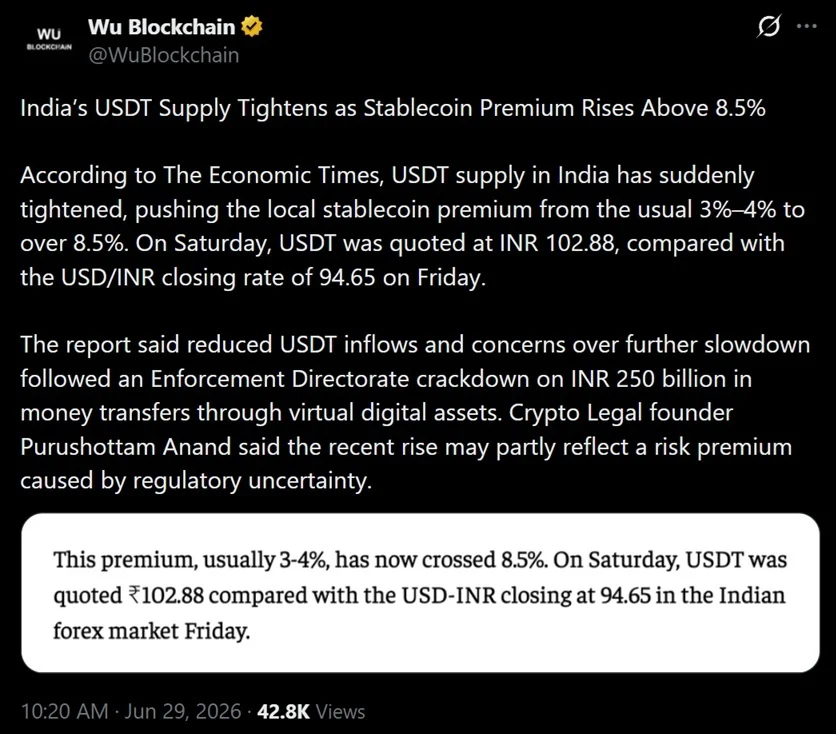
- USDT in India traded at INR 102.88, an 8.5%+ premium over the official 94.65 dollar rate, per Economic Times.
- The premium jumped from a typical 3%-4%, signaling a sharp local shortage of dollar-pegged tether.
- India ranks first globally for crypto adoption, where USDT is a core tool for traders and savers.
A Supply Squeeze in the World’s Top Crypto Market
The price of Tether’s USDT in India has surged well above its global value as a sudden tightening in supply rippled through the country’s crypto market. The local premium on the dollar-pegged stablecoin climbed above 8.5%, up from a typical range of 3% to 4%, meaning that a single USDT was quoted at 102.88 Indian rupees over the weekend (compared with an official USD/INR exchange rate of around 94.65).
Such gaps tend to widen when domestic demand for dollar exposure rises or when the flow of fresh stablecoin supply into a market slows, forcing traders to bid up the price on local exchanges.
India is the world’s most active crypto market, ranking first in global adoption for the third year running, per Chainalysis. In that market, Tether plays an outsized role. With a heavy tax regime on crypto gains and persistent currency volatility, many Indian traders and long-term holders use USDT to move between positions, preserve dollar value, and settle trades without touching the banking system.
Moreover, it bears mentioning that India imposes a flat 30% tax on crypto profits and a 1% tax deducted at source (TDS) on transactions, a structure that has pushed much trading activity toward peer-to-peer channels and offshore venues. In that environment, USDT functions as a de facto dollar account for users who want stable value without converting back to rupees and triggering fees at every step.
Subsequently, that reliance makes the premium more than a technical quirk because when USDT trades at an 8.5% markup, every trader using it to enter or exit a position effectively pays a hidden surcharge, eroding returns and signaling stress in the plumbing that connects India’s crypto users to the global dollar market.
A Tightening Global Backdrop
The premium also reflects India’s tight controls on moving money abroad as residents face limits on foreign-currency purchases, and buying dollars through traditional channels can be cumbersome. Stablecoins offer a frictionless workaround for this, so that when demand for dollar exposure rises, it can quickly outstrip the local supply of tokens, sending premiums sharply higher.
Globally, the stablecoin sector has swelled into one of crypto’s most important pillars, with the total market measured in the hundreds of billions of dollars and USDT the largest stablecoin in the world. The next thing to watch is whether fresh tether supply will flow back into Indian exchanges to close the gap, or whether the premium will persist as a sign of deeper friction between local demand and global supply.