
Over the last six weeks, investors have been privy to the tail-end of earnings season, the largest initial public offering (IPO) in history, and have witnessed the Dow Jones Industrial Average (^DJI +0.14%), S&P 500 (^GSPC +1.08%), and Nasdaq Composite (^IXIC +1.91%) rocket to record highs. But arguably, no event has been more meaningful than the changing of the guard at the Federal Reserve.
May 15 marked Jerome Powell’s final day as Fed chair, while May 22 was the official swearing-in ceremony of his successor, Kevin Warsh. Given that Warsh was a former Federal Open Market Committee (FOMC) member (Feb. 24, 2006 – March 31, 2011), he brought some level of experience to the position.

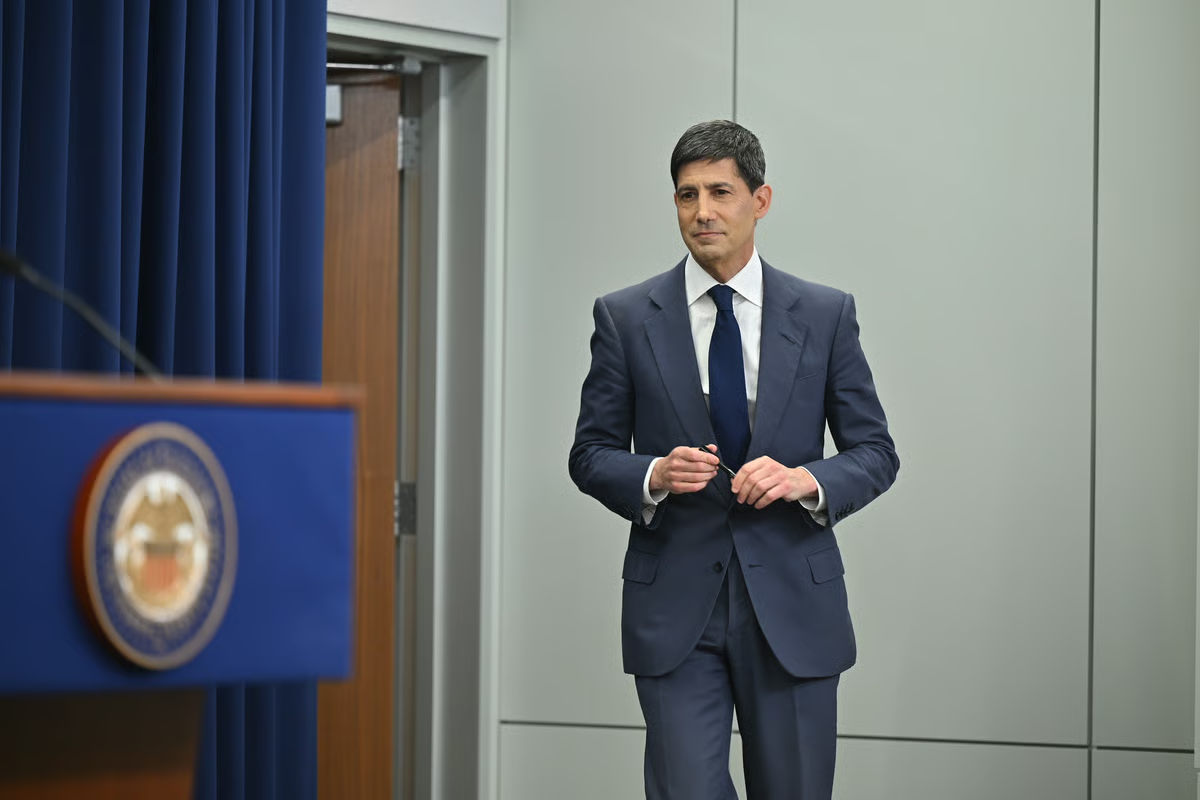
Fed Chair Kevin Warsh at his first post-FOMC meeting press conference. Image source: Official Federal Reserve Photo.
What Wall Street didn’t know, entering his first FOMC meeting as head of the Fed on June 17, was how he planned to lead America’s foremost financial institution. It took just six words for Warsh to lay out his game plan and to potentially spoil Wall Street’s party.
Fed Chair Warsh has his sights set on inflation
As expected, Warsh and Powell have very different leadership styles. Powell’s FOMC statements were often lengthy, detailed, and contained forward-looking projections. Meanwhile, Warsh favors concise statements that avoid forward-looking guidance and stick solely to the facts.
One of Warsh’s statements during his press conference after the FOMC meeting perfectly sums up his current mission at the central bank:
Persistently high prices are a burden for the American people. But the recent past need not be prologue. I am pleased to report that members of the FOMC are unambiguous and unanimous. This committee will deliver price stability.
Despite the Fed upholding the dual mandate of maximum employment and price stability, these six words, “this committee will deliver price stability,” show that Warsh intends to focus on inflation.
“If Trump wants someone easy on inflation, he got the wrong guy in Kevin Warsh.”@AnnaEconomist pic.twitter.com/FGMfeSqHpU
— Daily Chartbook (@dailychartbook) January 31, 2026
This shouldn’t come as a huge surprise, given that Kevin Warsh exhibited monetary hawk tendencies during his previous tenure on the FOMC. Even as the unemployment rate soared during the financial crisis, Warsh cautioned against lowering interest rates for fear of sparking inflation. He’s consistently favored higher interest rates as a tool to suppress inflation.
Between February and May, trailing 12-month inflation has jumped from a modest 2.4% to a three-year high of 4.2%. Though the price stickiness of President Trump’s tariffs has played a small role in this increase, the lion’s share of this inflationary surge can be traced to the Iran war. The largest crude oil supply disruption in modern history has wreaked havoc on energy markets.
According to the quarterly filed Summary of Economic Projections, nine of 18 FOMC members — Warsh abstained from providing forward-looking guidance, and not all 18 are voting members — expect interest rates to increase by the end of this year.
At the start of the year, the bond market was pricing in 2 Fed rate CUTS.
After today’s FOMC meeting, it is now pricing in 2 Fed rate HIKES.
That’s a 1% swing in expectations.
The 2-Year Treasury yield entered the year at 3.48%. It ended the day at 4.21%. pic.twitter.com/zvVru7ValQ
— Charlie Bilello (@charliebilello) June 17, 2026
A rate hike would signify that the central bank is serious about stabilizing prices. However, it would also represent a dagger in the proverbial heart of a historically expensive stock market.
When 2026 began, investors were looking for two rate cuts this year and a continuation of this easing cycle into 2027. Now, the forecast potentially calls for two rate hikes. With debt helping to finance the artificial intelligence data center build-out, one of Wall Street’s key growth drivers is at risk of being upended by the Warsh’s and FOMC’s mission of delivering price stability.